Advertisements
Advertisements
प्रश्न
Construct ☐ PQRS, such that l(PQ) = 3.5 cm, l(QR) = 5.6 cm, l(RS) = 3.5 cm, m∠Q = 110°, m∠R = 70°. If it is given that ☐ PQRS is a parallelogram, which of the given information is unnecessary?
Advertisements
उत्तर
Steps of Construction:
Step 1: Draw PQ = 3.5 cm.
Step 2: Draw ∠PQX = 110°.
Step 3: With Q as the center and a radius of 5.6 cm, draw an arc-cutting ray QX at R.
Step 4: Draw ∠QRY = 70°.
Step 5: With R as centre and radius 3.5 cm, draw an arc cutting ray RY at S.
Step 6: Join PS.
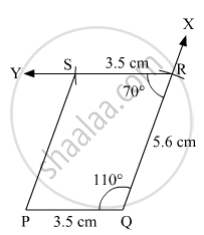
Here, PQRS is the required quadrilateral.
If it is given that quadrilateral PQRS is a parallelogram, then the information l(RS) = 3.5 cm and m∠R = 70° is unnecessary.
संबंधित प्रश्न
Name the quadrilaterals whose diagonals bisect each other
In parallelogram ABCD, ∠A = 3 times ∠B. Find all the angles of the parallelogram. In the same parallelogram, if AB = 5x – 7 and CD = 3x +1 ; find the length of CD.
In parallelogram ABCD, X and Y are midpoints of opposite sides AB and DC respectively. Prove that:
(i) AX = YC
(ii) AX is parallel to YC
(iii) AXCY is a parallelogram.
In the given figure, AB || EC, AB = AC and AE bisects ∠DAC. Prove that:
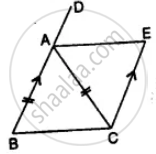
- ∠EAC = ∠ACB
- ABCE is a parallelogram.
If a triangle and a parallelogram lie on the same base and between the same parallels, then prove that the area of the triangle is equal to half of the area of parallelogram
Iron rods a, b, c, d, e, and f are making a design in a bridge as shown in the figure. If a || b, c || d, e || f, find the marked angles between b and c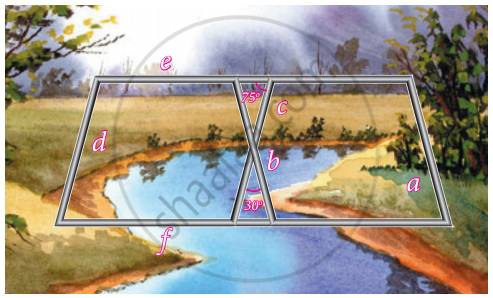
The adjacent sides of a parallelogram are 5 cm and 9 cm. Its perimeter is ______.
ABCD is a parallelogram. Points P and Q are taken on the sides AB and AD respectively and the parallelogram PRQA is formed. If ∠C = 45°, find ∠R.
Construct a parallelogram ABCD in which AB = 4 cm, BC = 5 cm and ∠B = 60°.
Construct a parallelogram HOME with HO = 6 cm, HE = 4 cm and OE = 3 cm.
