Advertisements
Advertisements
प्रश्न
Construct a parallelogram ABCD in which AB = 4 cm, BC = 5 cm and ∠B = 60°.
Advertisements
उत्तर
As we know that the opposite sides of a parallelogram are equal.
So, AB = DC = 4 cm
BC = AD = 5 cm
∠B = 60°
∠A + ∠B = 180° ...[Sum of cointerior angles]
∠A = 180°
Steps of construction:
Step I: Draw AB = 4 cm.
Step II: Draw ray BX that is ∠ABX = 60°.
Step III: Mark a point C that is BC = 5 cm.
Step IV: Draw a ray AY that is ∠YAB = 120.
Step V: Mark a point D that is AD = 5 cm.
Step VI: Join C and D.
Hence, ABCD is required parallelogram.
APPEARS IN
संबंधित प्रश्न
Given a parallelogram ABCD. Complete each statement along with the definition or property used.
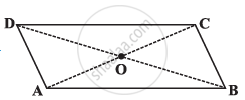
- AD = ______
- ∠DCB = ______
- OC = ______
- m∠DAB + m∠CDA = ______
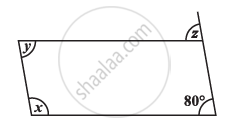
Consider the given parallelograms. Find the values of the unknowns x, y, z.
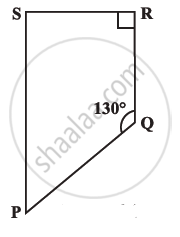
Find the measure of ∠P and ∠S, if `bar(SP) || bar(RQ)` in the following figure. (If you find m∠R, is there more than one method to find m∠P?).
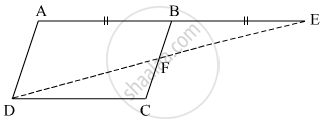
In the given figure, `square`ABCD is a parallelogram. Point E is on the ray AB such that BE = AB then prove that line ED bisects seg BC at point F.
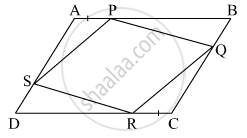
In the given figure, if points P, Q, R, S are on the sides of parallelogram such that AP = BQ = CR = DS then prove that `square`PQRS is a parallelogram.
In parallelogram PQRS, ∠Q = (4x – 5)° and ∠S = (3x + 10)°. Calculate: ∠Q and ∠R.
ABCD is a parallelogram. What kind of quadrilateral is it if: AC = BD but AC is not perpendicular to BD?
In parallelogram ABCD, X and Y are midpoints of opposite sides AB and DC respectively. Prove that:
(i) AX = YC
(ii) AX is parallel to YC
(iii) AXCY is a parallelogram.
Iron rods a, b, c, d, e, and f are making a design in a bridge as shown in the figure. If a || b, c || d, e || f, find the marked angles between d and e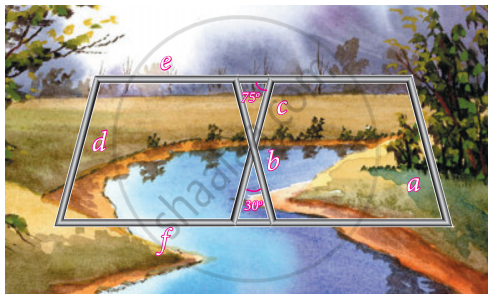
Construct a parallelogram HOME with HO = 6 cm, HE = 4 cm and OE = 3 cm.
