Advertisements
Advertisements
प्रश्न
Given a parallelogram ABCD. Complete each statement along with the definition or property used.
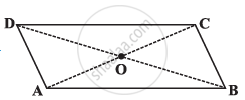
- AD = ______
- ∠DCB = ______
- OC = ______
- m∠DAB + m∠CDA = ______
Advertisements
उत्तर
- In a parallelogram, opposite sides are equal in length.
AD = BC - In a parallelogram, opposite angles are equal in measure.
∠DCB = ∠DAB - In a parallelogram, diagonals bisect each other.
Hence, OC = OA - In a parallelogram, adjacent angles are supplementary to each other.
Hence, m∠DAB + m∠CDA =180°
संबंधित प्रश्न
If the ratio of measures of two adjacent angles of a parallelogram is 1 : 2, find the measures of all angles of the parallelogram.
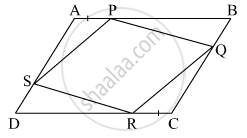
In the given figure, if points P, Q, R, S are on the sides of parallelogram such that AP = BQ = CR = DS then prove that `square`PQRS is a parallelogram.
Construct ☐ BARC such that l(BA) = l(BC) = 4.2 cm, l(AC) = 6.0 cm, l(AR) = l(CR) = 5.6 cm
Referring the adjacent figure of a parallelogram, write the answer of questions given below.
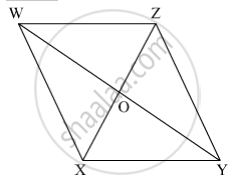
(1) If l(WZ) = 4.5 cm then l(XY) = ?
(2) If l(YZ) = 8.2 cm then l(XW) = ?
(3) If l(OX) = 2.5 cm then l(OZ) = ?
(4) If l(WO) = 3.3 cm then l(WY) = ?
(5) If m∠WZY = 120° then m∠WXY = ? and m∠XWZ = ?
In parallelogram PQRS, ∠Q = (4x – 5)° and ∠S = (3x + 10)°. Calculate: ∠Q and ∠R.
ABCD is a parallelogram. What kind of quadrilateral is it if: AC is perpendicular to BD but is not equal to it?
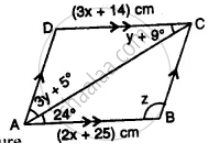
Use the information given in the alongside diagram to find the value of x, y, and z.
The adjacent sides of a parallelogram are 5 cm and 9 cm. Its perimeter is ______.
A diagonal of a parallelogram bisects an angle. Will it also bisect the other angle? Give reason.
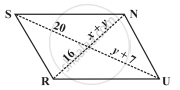
The following figure RUNS is parallelogram. Find x and y. (Lengths are in cm)