Advertisements
Advertisements
प्रश्न
If two adjacent angles of a parallelogram are (5x – 5)° and (10x + 35)°, then the ratio of these angles is ______.
विकल्प
1 : 3
2 : 3
1 : 4
1 : 2
Advertisements
उत्तर
If two adjacent angles of a parallelogram are (5x – 5)° and (10x + 35)°, then the ratio of these angles is 1 : 3.
Explanation:
We know that, adjacent angles of a parallelogram are supplementary, i.e. their sum equals 180°.
∴ (5x – 5) + (10x + 35) = 180°
⇒ 15x + 30° = 180°
⇒ 15x = 150°
⇒ x = 10°
Thus, the angles are (5 × 10 – 5) and (10 × 10 + 35), i.e. 45° and 135°.
Hence, the required ratio is 45° : 135°, i.e. 1 : 3.
APPEARS IN
संबंधित प्रश्न
Consider the given parallelogram. Find the values of the unknowns x, y, z.

Can a quadrilateral ABCD be a parallelogram if AB = DC = 8 cm, AD = 4 cm and BC = 4.4 cm?
In parallelogram ABCD, ∠A = 3 times ∠B. Find all the angles of the parallelogram. In the same parallelogram, if AB = 5x – 7 and CD = 3x +1 ; find the length of CD.
Given: Parallelogram ABCD in which diagonals AC and BD intersect at M.
Prove: M is the mid-point of LN.
In the following diagram, the bisectors of interior angles of the parallelogram PQRS enclose a quadrilateral ABCD.

Show that:
(i) ∠PSB + ∠SPB = 90°
(ii) ∠PBS = 90°
(iii) ∠ABC = 90°
(iv) ∠ADC = 90°
(v) ∠A = 90°
(vi) ABCD is a rectangle
Thus, the bisectors of the angles of a parallelogram enclose a rectangle.
The given figure shows parallelogram ABCD. Points M and N lie in diagonal BD such that DM = BN.

Prove that:
(i) ∆DMC = ∆BNA and so CM = AN
(ii) ∆AMD = ∆CNB and so AM CN
(iii) ANCM is a parallelogram.
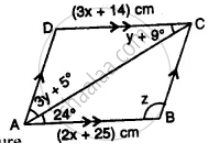
Use the information given in the alongside diagram to find the value of x, y, and z.
In the given figure, AB || EC, AB = AC and AE bisects ∠DAC. Prove that:

- ∠EAC = ∠ACB
- ABCE is a parallelogram.
If a triangle and a parallelogram lie on the same base and between the same parallels, then prove that the area of the triangle is equal to half of the area of parallelogram
In parallelogram PQRS, O is the mid point of SQ. Find ∠S, ∠R, PQ, QR and diagonal PR.

