Advertisements
Advertisements
Question
If two adjacent angles of a parallelogram are (5x – 5)° and (10x + 35)°, then the ratio of these angles is ______.
Options
1 : 3
2 : 3
1 : 4
1 : 2
Advertisements
Solution
If two adjacent angles of a parallelogram are (5x – 5)° and (10x + 35)°, then the ratio of these angles is 1 : 3.
Explanation:
We know that, adjacent angles of a parallelogram are supplementary, i.e. their sum equals 180°.
∴ (5x – 5) + (10x + 35) = 180°
⇒ 15x + 30° = 180°
⇒ 15x = 150°
⇒ x = 10°
Thus, the angles are (5 × 10 – 5) and (10 × 10 + 35), i.e. 45° and 135°.
Hence, the required ratio is 45° : 135°, i.e. 1 : 3.
APPEARS IN
RELATED QUESTIONS
Given a parallelogram ABCD. Complete each statement along with the definition or property used.
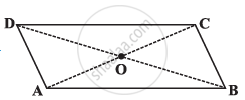
- AD = ______
- ∠DCB = ______
- OC = ______
- m∠DAB + m∠CDA = ______
Consider the given parallelograms. Find the values of the unknowns x, y, z.

Can a quadrilateral ABCD be a parallelogram if ∠A = 70° and ∠C = 65°?
Name the quadrilaterals whose diagonals bisect each other
ABCD is a parallelogram. What kind of quadrilateral is it if: AC is perpendicular to BD but is not equal to it?
ABCD is a parallelogram. What kind of quadrilateral is it if: AC = BD but AC is not perpendicular to BD?
Prove that the diagonals of a parallelogram bisect each other.
In parallelogram ABCD, E is the mid-point of AD and F is the mid-point of BC. Prove that BFDE is a parallelogram.
Iron rods a, b, c, d, e, and f are making a design in a bridge as shown in the figure. If a || b, c || d, e || f, find the marked angles between d and e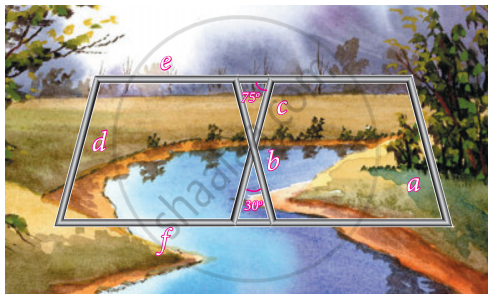
Construct a parallelogram ABCD in which AB = 4 cm, BC = 5 cm and ∠B = 60°.
