Advertisements
Advertisements
Question
The measures of two adjacent angles of a parallelogram are in the ratio 3 : 2. Find the measure of each of the angles of the parallelogram.
Advertisements
Solution
Let the measures of two adjacent angles, ∠A and ∠B, of parallelogram ABCD are in the ratio of 3 : 2. Let ∠A = 3x and ∠B = 2x
We know that the sum of the measures of adjacent angles is 180º for a parallelogram.
∠A + ∠B = 180º
3x + 2x = 180º
5x = 180º
`x = 180^circ/5 = 36`
∠A = ∠C = 3x = 108º (Opposite angles)
∠B = ∠D = 2x = 72º (Opposite angles)
Thus, the measures of the angles of the parallelogram are 108º, 72º, 108º, and 72º
RELATED QUESTIONS
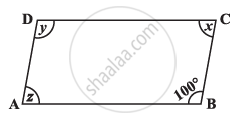
Consider the given parallelogram. Find the values of the unknowns x, y, z.
Can a quadrilateral ABCD be a parallelogram if AB = DC = 8 cm, AD = 4 cm and BC = 4.4 cm?
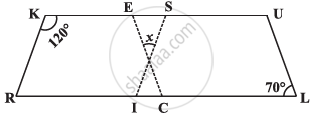
In the above figure both RISK and CLUE are parallelograms. Find the value of x.
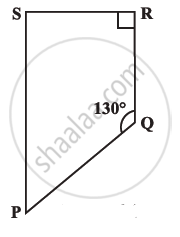
Find the measure of ∠P and ∠S, if `bar(SP) || bar(RQ)` in the following figure. (If you find m∠R, is there more than one method to find m∠P?).
Perimeter of a parallelogram is 150 cm. One of its sides is greater than the other side by 25 cm. Find the lengths of all sides.
Prove that the diagonals of a parallelogram bisect each other.
All rectangles are parallelograms.
ABCD is a parallelogram. Points P and Q are taken on the sides AB and AD respectively and the parallelogram PRQA is formed. If ∠C = 45°, find ∠R.
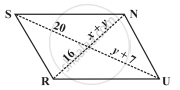
The following figure RUNS is parallelogram. Find x and y. (Lengths are in cm)
Draw a rough figure of a quadrilateral that is not a parallelogram but has exactly two opposite angles of equal measure.
