Advertisements
Advertisements
Question
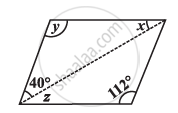
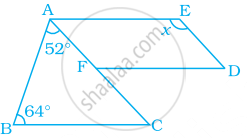
Consider the given parallelograms. Find the values of the unknowns x, y, z.
Advertisements
Solution
y = 112° (Opposite angles are equal)
x + y + 40° = 180° (Angle sum property of triangles)
x + 112° + 40° = 180°
x + 152° = 180°
x = 28°
z = x = 28° (Alternate interior angles)
RELATED QUESTIONS
Can a quadrilateral ABCD be a parallelogram if ∠A = 70° and ∠C = 65°?
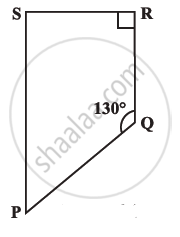
Find the measure of ∠P and ∠S, if `bar(SP) || bar(RQ)` in the following figure. (If you find m∠R, is there more than one method to find m∠P?).
Name the quadrilaterals whose diagonals bisect each other
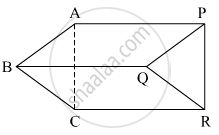
In the adjacent figure, if seg AB || seg PQ, seg AB ≅ seg PQ, seg AC || seg PR, seg AC ≅ seg PR then prove that, seg BC || seg QR and seg BC ≅ seg QR.
Referring the adjacent figure of a parallelogram, write the answer of questions given below.
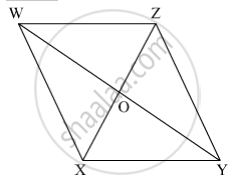
(1) If l(WZ) = 4.5 cm then l(XY) = ?
(2) If l(YZ) = 8.2 cm then l(XW) = ?
(3) If l(OX) = 2.5 cm then l(OZ) = ?
(4) If l(WO) = 3.3 cm then l(WY) = ?
(5) If m∠WZY = 120° then m∠WXY = ? and m∠XWZ = ?
In parallelogram MODE, the bisector of ∠M and ∠O meet at Q, find the measure of ∠MQO.
ABCD is a parallelogram. The bisector of angle A intersects CD at X and bisector of angle C intersects AB at Y. Is AXCY a parallelogram? Give reason.
ABCD is a parallelogram. Points P and Q are taken on the sides AB and AD respectively and the parallelogram PRQA is formed. If ∠C = 45°, find ∠R.
In the following figure, FD || BC || AE and AC || ED. Find the value of x.
Draw a rough figure of a quadrilateral that is not a parallelogram but has exactly two opposite angles of equal measure.
