Advertisements
Advertisements
Question
Can a quadrilateral ABCD be a parallelogram if ∠D + ∠B = 180°?
Advertisements
Solution
For ∠D + ∠B = 180°, quadrilateral ABCD may or may not be a parallelogram. Along with this condition, the following conditions should also be fulfilled.
The sum of the measures of adjacent angles should be 180º.
Opposite angles should also be of same measures.
RELATED QUESTIONS
The following figure GUNS is a parallelogram. Find x and y. (Lengths are in cm)
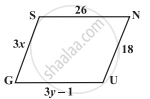
Perimeter of a parallelogram is 150 cm. One of its sides is greater than the other side by 25 cm. Find the lengths of all sides.
In the given figure, `square`PQRS and `square`ABCR are two parallelograms. If ∠P = 110° then find the measures of all angles of `square`ABCR.

The given figure shows parallelogram ABCD. Points M and N lie in diagonal BD such that DM = BN.

Prove that:
(i) ∆DMC = ∆BNA and so CM = AN
(ii) ∆AMD = ∆CNB and so AM CN
(iii) ANCM is a parallelogram.
If a triangle and a parallelogram lie on the same base and between the same parallels, then prove that the area of the triangle is equal to half of the area of parallelogram
Which of the following is a property of a parallelogram?
If two adjacent angles of a parallelogram are (5x – 5)° and (10x + 35)°, then the ratio of these angles is ______.
All rectangles are parallelograms.
A diagonal of a parallelogram bisects an angle. Will it also bisect the other angle? Give reason.
Construct a parallelogram ABCD in which AB = 4 cm, BC = 5 cm and ∠B = 60°.
