Advertisements
Advertisements
Question
In the following diagram, the bisectors of interior angles of the parallelogram PQRS enclose a quadrilateral ABCD.
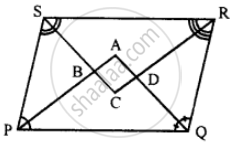
Show that:
(i) ∠PSB + ∠SPB = 90°
(ii) ∠PBS = 90°
(iii) ∠ABC = 90°
(iv) ∠ADC = 90°
(v) ∠A = 90°
(vi) ABCD is a rectangle
Thus, the bisectors of the angles of a parallelogram enclose a rectangle.
Advertisements
Solution
Given: In parallelogram ABCD bisector of angles P and Q, meet at A, bisectors of ∠R and ∠S meet at C. Forming a quadrilateral ABCD as shown in the figure.
To prove :
(i) ∠PSB + ∠SPB = 90°
(ii) ∠PBS = 90°
(iii) ∠ABC = 90°
(iv) ∠ADC = 90°
(v) ∠A = 9°
(vi) ABCD is a rectangle
Proof : In parallelogram PQRS,
PS || QR (opposite sides)
(i) ∠P +∠Q = 180°
= `(∠P)/2 + (∠S)/2 = 90°`
= ∠SPB + ∠PSB = 90°`
(ii) In tringle ∠PBS = 90°
∠SPB + ∠PSB + ∠PBS = 180°
= 90° + ∠PSB = 180°
= ∠PSB = 90°
(iii) ∠ABC = 90°
∠PBS = ∠ABC {vertically opposite}
∠ABC = 90°
(iv) In ∠ADC = 90°
`R/2 + Q/2 + RDQ = 180°`
RDQ = 180 - 90
RDQ = 90°
∴ ∠ADC = 90° {vertically opposite}
(v) ∠A = 90°
Similarly PQ || SR
∠PSB + SPB = 90°
(vi) ABCD is a rectangle (Each angle of a quadrilateral is 90°)
Hence proved.
APPEARS IN
RELATED QUESTIONS
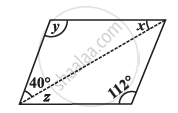
Consider the given parallelograms. Find the values of the unknowns x, y, z.
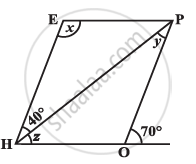
The adjacent figure HOPE is a parallelogram. Find the angle measures x, y and z. State the properties you use to find them.
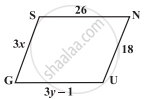
The following figure GUNS is a parallelogram. Find x and y. (Lengths are in cm)
Name the quadrilaterals whose diagonals bisect each other
Ratio of consecutive angles of a quadrilateral is 1 : 2 : 3 : 4. Find the measure of its each angle. Write, with reason, what type of a quadrilateral it is.
Construct a parallelogram ABCD such that l(BC) = 7 cm, m∠ABC = 40° , l(AB) = 3 cm.
ABCD is a parallelogram. What kind of quadrilateral is it if: AC is perpendicular to BD but is not equal to it?
If a triangle and a parallelogram lie on the same base and between the same parallels, then prove that the area of the triangle is equal to half of the area of parallelogram
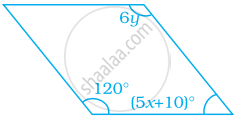
Find the values of x and y in the following parallelogram.
ABCD is a parallelogram. The bisector of angle A intersects CD at X and bisector of angle C intersects AB at Y. Is AXCY a parallelogram? Give reason.
