Advertisements
Advertisements
Question
Prove that the diagonals of a parallelogram bisect each other.
Advertisements
Solution

Given: ||gm ABCD in which diagonals AC and BD bisect each other.
To Prove : OA = OC and OB = OD
Proof : AB || CD (Given)
∠1 = ∠2 (alternate ∠s)
∠3 = ∠4 = (alternate ∠s)
and AB = CD (opposite sides of //gm)
∆COD = ∆AOB (A.S.A. rule)
OA = OC and OB = OD
Hence the result.
APPEARS IN
RELATED QUESTIONS
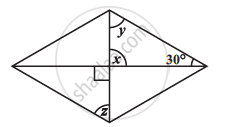
Consider the given parallelograms. Find the values of the unknowns x, y, z.
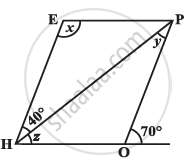
The adjacent figure HOPE is a parallelogram. Find the angle measures x, y and z. State the properties you use to find them.
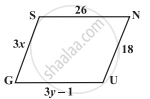
The following figure GUNS is a parallelogram. Find x and y. (Lengths are in cm)
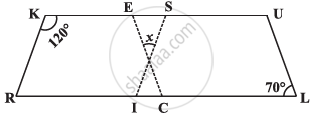
In the above figure both RISK and CLUE are parallelograms. Find the value of x.
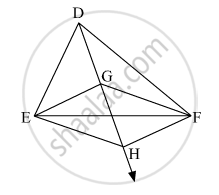
In the given figure, G is the point of concurrence of medians of ΔDEF. Take point H on ray DG such that D-G-H and DG = GH, then prove that `square`GEHF is a parallelogram.
In parallelogram ABCD, E is the mid-point of side AB and CE bisects angle BCD. Prove that:
- AE = AD,
- DE bisects and ∠ADC and
- Angle DEC is a right angle.
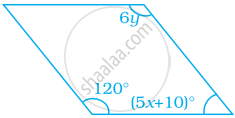
Find the values of x and y in the following parallelogram.
Two angles of a quadrilateral are each of measure 75° and the other two angles are equal. What is the measure of these two angles? Name the possible figures so formed.
Construct a parallelogram ABCD in which AB = 4 cm, BC = 5 cm and ∠B = 60°.
Construct a parallelogram when one of its side is 4 cm and its two diagonals are 5.6 cm and 7 cm. Measure the other side.
