Advertisements
Advertisements
प्रश्न
Prove that the diagonals of a parallelogram bisect each other.
Advertisements
उत्तर

Given: ||gm ABCD in which diagonals AC and BD bisect each other.
To Prove : OA = OC and OB = OD
Proof : AB || CD (Given)
∠1 = ∠2 (alternate ∠s)
∠3 = ∠4 = (alternate ∠s)
and AB = CD (opposite sides of //gm)
∆COD = ∆AOB (A.S.A. rule)
OA = OC and OB = OD
Hence the result.
APPEARS IN
संबंधित प्रश्न
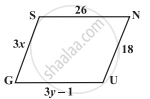
The following figure GUNS is a parallelogram. Find x and y. (Lengths are in cm)
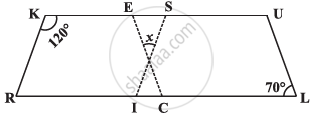
In the above figure both RISK and CLUE are parallelograms. Find the value of x.
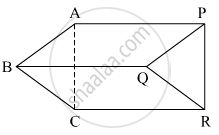
In the adjacent figure, if seg AB || seg PQ, seg AB ≅ seg PQ, seg AC || seg PR, seg AC ≅ seg PR then prove that, seg BC || seg QR and seg BC ≅ seg QR.
Construct ☐ PQRS, such that l(PQ) = 3.5 cm, l(QR) = 5.6 cm, l(RS) = 3.5 cm, m∠Q = 110°, m∠R = 70°. If it is given that ☐ PQRS is a parallelogram, which of the given information is unnecessary?
ABCD is a parallelogram. What kind of quadrilateral is it if: AC is perpendicular to BD but is not equal to it?
In parallelogram ABCD, E is the mid-point of AD and F is the mid-point of BC. Prove that BFDE is a parallelogram.
If two adjacent angles of a parallelogram are (5x – 5)° and (10x + 35)°, then the ratio of these angles is ______.
The angle between the two altitudes of a parallelogram through the same vertex of an obtuse angle of the parallelogram is 30°. The measure of the obtuse angle is ______.
In parallelogram MODE, the bisector of ∠M and ∠O meet at Q, find the measure of ∠MQO.
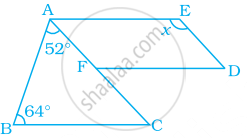
In the following figure, FD || BC || AE and AC || ED. Find the value of x.