Advertisements
Advertisements
प्रश्न
In parallelogram ABCD, the angle bisector of ∠A bisects BC. Will angle bisector of B also bisect AD? Give reason.
Advertisements
उत्तर
Given, ABCD is a parallelogram, bisector of ∠A, bisects BC at F, i.e. ∠1 = ∠2, CF = FB.
Draw FE || BA.
ABFE is a parallelogram by construction ...[∵ FE || BA]
⇒ ∠1 = ∠6 ...[Alternate angle]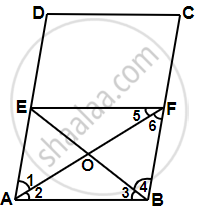
But ∠1 = ∠2 ...[Given]
∴ ∠2 = ∠6
AB = FB [Opposite sides to equal angles are equal] ...(i)
∴ ABFE is a rhombus.
Now, In ΔABO and ΔBOF,
AB = BF ...[From equation (i)]
BO = BO ...[Common]
AO = FO ...[Diagonals of rhombus bisect each other]
∴ ΔABO ≅ ΔBOF ...[By SSS]
∠3 = ∠4 ...[By CPCT]
Now, BF = `1/2` BC ...[Given]
⇒ BF = `1/2` AD ...[BC = AD]
⇒ AE = `1/2` AD ...[BF = AE]
∴ E is the midpoint of AD.
APPEARS IN
संबंधित प्रश्न
Consider the given parallelogram. Find the values of the unknowns x, y, z.
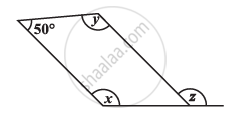
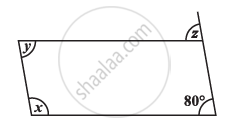
Consider the given parallelograms. Find the values of the unknowns x, y, z.
Can a quadrilateral ABCD be a parallelogram if ∠D + ∠B = 180°?
If the ratio of measures of two adjacent angles of a parallelogram is 1 : 2, find the measures of all angles of the parallelogram.
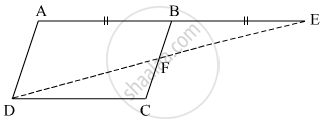
In the given figure, `square`ABCD is a parallelogram. Point E is on the ray AB such that BE = AB then prove that line ED bisects seg BC at point F.
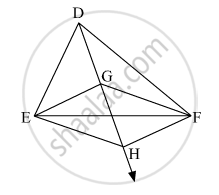
In the given figure, G is the point of concurrence of medians of ΔDEF. Take point H on ray DG such that D-G-H and DG = GH, then prove that `square`GEHF is a parallelogram.
PQRS is a parallelogram whose diagonals intersect at M.
If ∠PMS = 54°, ∠QSR = 25° and ∠SQR = 30° ; find :
(i) ∠RPS
(ii) ∠PRS
(iii) ∠PSR.
The given figure shows parallelogram ABCD. Points M and N lie in diagonal BD such that DM = BN.
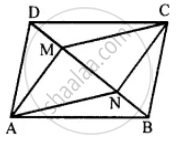
Prove that:
(i) ∆DMC = ∆BNA and so CM = AN
(ii) ∆AMD = ∆CNB and so AM CN
(iii) ANCM is a parallelogram.
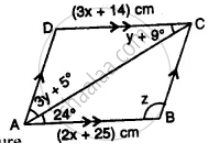
Use the information given in the alongside diagram to find the value of x, y, and z.
ABCD is a parallelogram. Points P and Q are taken on the sides AB and AD respectively and the parallelogram PRQA is formed. If ∠C = 45°, find ∠R.
