Advertisements
Advertisements
प्रश्न
ABCD is a parallelogram. The bisector of angle A intersects CD at X and bisector of angle C intersects AB at Y. Is AXCY a parallelogram? Give reason.
Advertisements
उत्तर
Given, ABCD is a parallelogram,
So, ∠A = ∠C ...[∵ Opposite angles of a parallelogram are equal]
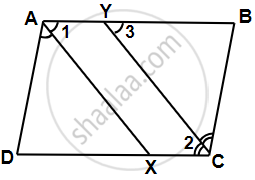
∴ `(∠A)/2 = (∠C)/2` ...[Dividing both the sides by 2]
∠1 = ∠2 ...[Alternative angles]
But ∠2 = ∠3 ...[∵ AB || CD and CY is the transerval]
∴ ∠1 = ∠3
But they are pair of corresponding angles.
∴ AX || YC ...(i)
AY || XC [∵ AB || DC] ...(ii)
From equations (i) and (ii), we get
AXCY is a parallelogram.
APPEARS IN
संबंधित प्रश्न
Given a parallelogram ABCD. Complete each statement along with the definition or property used.
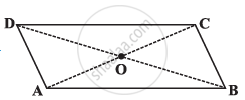
- AD = ______
- ∠DCB = ______
- OC = ______
- m∠DAB + m∠CDA = ______
Consider the given parallelogram. Find the values of the unknowns x, y, z.
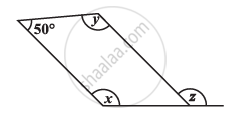
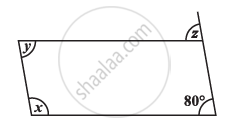
Consider the given parallelograms. Find the values of the unknowns x, y, z.
Can a quadrilateral ABCD be a parallelogram if ∠D + ∠B = 180°?
Name the quadrilaterals whose diagonals bisect each other
In parallelogram ABCD, X and Y are midpoints of opposite sides AB and DC respectively. Prove that:
(i) AX = YC
(ii) AX is parallel to YC
(iii) AXCY is a parallelogram.
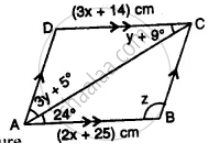
Use the information given in the alongside diagram to find the value of x, y, and z.
Iron rods a, b, c, d, e, and f are making a design in a bridge as shown in the figure. If a || b, c || d, e || f, find the marked angles between d and e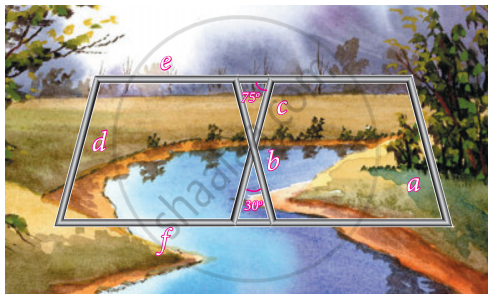
Which of the following is a property of a parallelogram?
All rectangles are parallelograms.
