Advertisements
Advertisements
प्रश्न
A line l is parallel to line m and a transversal p intersects them at X, Y respectively. Bisectors of interior angles at X and Y interesct at P and Q. Is PXQY a rectangle? Given reason.
Advertisements
उत्तर
Given, l || m
Now, ∠DXY = ∠XYA ...[Alternate interior angles]
⇒ `(∠DXY)/2 = (∠XYA)/2` ...[Dividing both the sides by 2]
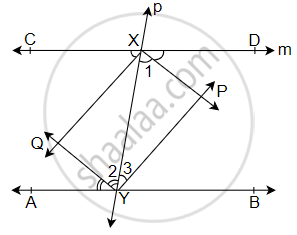
Now, ∠1 = ∠2 ...[Alternate angle are equal]
XP and YQ are bisectors.
So, XP || QY ...(i)
Similarly, XQ || PY ...(ii)
Now, from equation (i) and (ii), we get
In parallelogram PXQY,
∠DXY + ∠XYB = 180° ...(iii) [Interior angles on the same side of transversal are supplementary]
Now, dividing both the sides by 2, get
`(∠DXY)/2 + (∠XYB)/2 = 180^circ/2`
So, ∠1 + ∠3 = 90° [Dividing both the sides by 2] ...(iv)
In triangle XYP,
∠1 + ∠3 + ∠P = 180°
90° + ∠P = 180° ...[From equation (iv)]
∠P = 180° – 90°
∠P = 90° ...(v)
From equations (iii) and (v),
PXQY is a rectangle.
APPEARS IN
संबंधित प्रश्न
Which of the following statement is true for a rectangle?
Its diagonals are perpendicular.
A window frame has one diagonal longer than the other. Is the window frame a rectangle? Why or why not?
In a rectangle ABCD, prove that ∆ACB ≅ ∆CAD.
A mason has made a concrete slab. He needs it to be rectangular. In what different ways can he make sure that it is rectangular?
Diagonals of a rectangle ABCD intersect at point O. If AC = 8 cm then find BO and if ∠CAD =35° then find ∠ACB.
State with reason whether the following statement is ‘true’ or ‘false’.
Every parallelogram is a rectangle.
Draw a rectangle ABCD such that l(AB) = 6.0 cm and l (BC) = 4.5 cm.
The interior angle made by the side in a parallelogram is 90° then the parallelogram is a
PQRS is a rectangle. The perpendicular ST from S on PR divides ∠S in the ratio 2:3. Find ∠TPQ.
Quadrilateral EFGH is a rectangle in which J is the point of intersection of the diagonals. Find the value of x if JF = 8x + 4 and EG = 24x – 8.
