Advertisements
Advertisements
प्रश्न
In a rectangle ABCD, prove that ∆ACB ≅ ∆CAD.
Advertisements
उत्तर

In ∆ACB and ∆CAD:
AB = CD (rectangle property)
AD = BC (rectangle property)
AC ( common side )
Hence, by SSS criterion, it is proved that\[∆ ACB \cong ∆ CAD\]
संबंधित प्रश्न
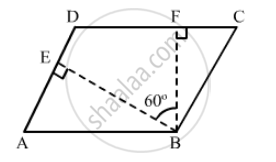
The angle between the altitudes of a parallelogram, through the same vertex of an obtuse angle of the parallelogram is 60°. Find the angles of the parallelogram.
In Fig. 17.29, suppose it is known that DE = DF. Then, is ΔABC isosceles? Why or why not?
Which of the following statement is true for a rectangle?
It has two pairs of equal sides.
The sides of a rectangle are in the ratio 4 : 5. Find its sides if the perimeter is 90 cm.
Find the length of the diagonal of a rectangle whose sides are 12 cm and 5 cm.
Adjacent sides of a rectangle are 7 cm and 24 cm. Find the length of its diagonal.
If the diagonals of a parallelogram are of equal lengths, the parallelogram is a rectangle. Prove it.
Rectangle is a regular quadrilateral.
If diagonals of a quadrilateral are equal, it must be a rectangle.
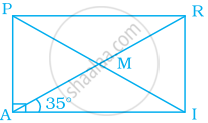
In rectangle PAIR, find ∠ARI, ∠RMI and ∠PMA.