Advertisements
Advertisements
प्रश्न
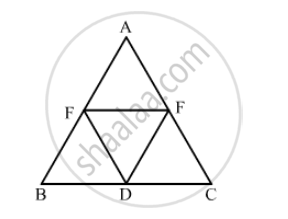
In the following figure, BDEF and DCEF are each a parallelogram. Is it true that BD = DC? Why or why not?
Advertisements
उत्तर
\[\text{ In parallelogram BDEF }\]
\[ \therefore BD = EF . . . (i) (\text{ opposite sides of a parallelogram are equal })\]
\[\text{ In parallelogram DCEF }\]
\[ CD = EF . . . (ii) (\text{ opposite sides of a parallelogram are equal })\]
\[\text{ From equations (i) and } (ii)\]
\[BD = CD\]
संबंधित प्रश्न
Explain why a rectangle is a convex quadrilateral.
In Fig. 17.29, suppose it is known that DE = DF. Then, is ΔABC isosceles? Why or why not?
Which of the following statement is true for a rectangle?
Its diagonals are equal.
Which of the following statement is true for a rectangle?
Its diagonals bisect each other.
Which of the following statement are true for a square?
It has all its sides of equal length.
Fill in the blank in the following, so as to make the statement true:
A rectangle is a parallelogram in which .....
A mason has made a concrete slab. He needs it to be rectangular. In what different ways can he make sure that it is rectangular?
Diagonals of a rectangle PQRS are intersecting in point M. If ∠QMR = 50° find the measure of ∠MPS.
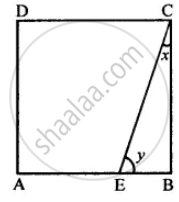
The following figure is a rectangle in which x: y = 3: 7; find the values of x and y.
If diagonals of a quadrilateral are equal, it must be a rectangle.
