Advertisements
Advertisements
प्रश्न
Which of the following statement is true for a rectangle?
Its diagonals are equal and perpendicular, and bisect each other.
Advertisements
उत्तर
False
The diagonals are not perpendicular to each other.
संबंधित प्रश्न
The shorter side of a parallelogram is 4.8 cm and the longer side is half as much again as the shorter side. Find the perimeter of the parallelogram.
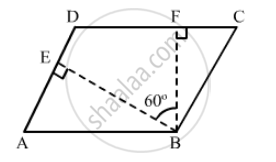
The angle between the altitudes of a parallelogram, through the same vertex of an obtuse angle of the parallelogram is 60°. Find the angles of the parallelogram.
Which of the following statement true for a square?
Its diagonals are equal to its sides.
Using opposite angles test for parallelogram, prove that every rectangle is a parallelogram.
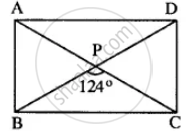
ABCD is a rectangle, if ∠BPC = 124°
Calculate:
- ∠BAP
- ∠ADP
If the diagonals of a parallelogram are of equal lengths, the parallelogram is a rectangle. Prove it.
The interior angle made by the side in a parallelogram is 90° then the parallelogram is a
If the diagonals of a quadrilateral are equal and bisect each other, then the quadrilateral is a ______.
Quadrilateral EFGH is a rectangle in which J is the point of intersection of the diagonals. Find the value of x if JF = 8x + 4 and EG = 24x – 8.
A line l is parallel to line m and a transversal p intersects them at X, Y respectively. Bisectors of interior angles at X and Y interesct at P and Q. Is PXQY a rectangle? Given reason.
