Advertisements
Advertisements
प्रश्न
Which of the following statement is true for a rectangle?
Its diagonals are equal and perpendicular, and bisect each other.
Advertisements
उत्तर
False
The diagonals are not perpendicular to each other.
संबंधित प्रश्न
Two adjacent angles of a parallelogram are (3x − 4)° and (3x + 10)°. Find the angles of the parallelogram.
Fill in the blank in the following, so as to make the statement true:
A square is a rhombus in which .....
Fill in the blank of the following, so as to make the statement true:
A square is a rectangle in which .....
A window frame has one diagonal longer than the other. Is the window frame a rectangle? Why or why not?
Draw a rectangle whose one side measures 8 cm and the length of each of whose diagonals is 10 cm.
Using opposite angles test for parallelogram, prove that every rectangle is a parallelogram.
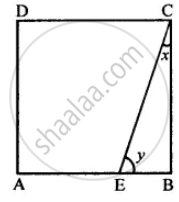
The following figure is a rectangle in which x: y = 3: 7; find the values of x and y.
If the adjacent angles of a parallelogram are equal, then the parallelogram is a ______.
Every rectangle is a trapezium.
PQRS is a rectangle. The perpendicular ST from S on PR divides ∠S in the ratio 2:3. Find ∠TPQ.
