Advertisements
Advertisements
प्रश्न
PQRS is a rectangle. The perpendicular ST from S on PR divides ∠S in the ratio 2:3. Find ∠TPQ.
Advertisements
उत्तर
Given, ST ⊥ PR and ST divides ∠S in the ratio 2:3
So, sum of ratio = 2 + 3 = 5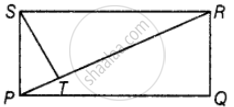
Now, `∠TSP = 2/5 xx 90^circ = 36^circ, ∠TSR = 3/5 xx 90^circ = 54^circ`
Also, by the angle sum property of a triangle,
∠TPS = 180° – (∠STP + ∠TSP)
= 180° – (90° + 36°)
= 54°
We know that, ∠SPQ = 90°
⇒ ∠TPS + ∠TPQ = 90°
⇒ 54° + ∠TPQ = 90°
⇒ ∠TPQ = 90° – 54° = 36°
APPEARS IN
संबंधित प्रश्न
The shorter side of a parallelogram is 4.8 cm and the longer side is half as much again as the shorter side. Find the perimeter of the parallelogram.
Which of the following statement is true for a rectangle?
Its diagonals bisect each other.
Which of the following statement is true for a square?
It is a rectangle.
Which of the following statement true for a square?
Its diagonals are equal to its sides.
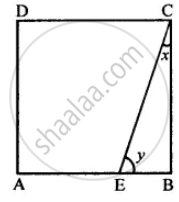
The following figure is a rectangle in which x: y = 3: 7; find the values of x and y.
For which of the following figures, all angles are equal?
A quadrilateral whose opposite sides and all the angles are equal is a ______.
Rectangle is a regular quadrilateral.
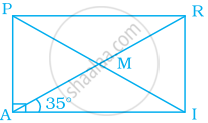
In rectangle PAIR, find ∠ARI, ∠RMI and ∠PMA.
A line l is parallel to line m and a transversal p intersects them at X, Y respectively. Bisectors of interior angles at X and Y interesct at P and Q. Is PXQY a rectangle? Given reason.
