Advertisements
Advertisements
प्रश्न
Which of the following statement is true for a square?
It is a rectangle.
Advertisements
उत्तर
True
संबंधित प्रश्न
Explain why a rectangle is a convex quadrilateral.
Which of the following statement is true for a rectangle?
It has two pairs of equal sides.
Which of the following statement is true for a rectangle?
All rectangles are squares.
Fill in the blank of the following, so as to make the statement true:
A square is a rectangle in which .....
The sides of a rectangle are in the ratio 2 : 3, and its perimeter is 20 cm. Draw the rectangle.
Using opposite angles test for parallelogram, prove that every rectangle is a parallelogram.
State with reason whether the following statement is ‘true’ or ‘false’.
Every parallelogram is a rectangle.
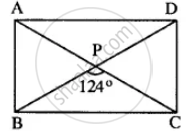
ABCD is a rectangle, if ∠BPC = 124°
Calculate:
- ∠BAP
- ∠ADP
A quadrilateral whose opposite sides and all the angles are equal is a ______.
Every parallelogram is a rectangle.
