Advertisements
Advertisements
प्रश्न
The shorter side of a parallelogram is 4.8 cm and the longer side is half as much again as the shorter side. Find the perimeter of the parallelogram.
Advertisements
उत्तर
\[\text{ Given }: \]
\[\text{ Shorter side } = 4 . 8 cm\]
\[\text{ Longer side } = \frac{4 . 8}{2} + 4 . 8 = 7 . 2 cm\]
\[\text{ Perimeter = Sum of all the sides } \]
\[ = 4 . 8 + 4 . 8 + 7 . 2 + 7 . 2\]
\[ = 24 \text{ cm }\]
संबंधित प्रश्न
Two adjacent angles of a parallelogram are (3x − 4)° and (3x + 10)°. Find the angles of the parallelogram.
In the following figure, BDEF and DCEF are each a parallelogram. Is it true that BD = DC? Why or why not?
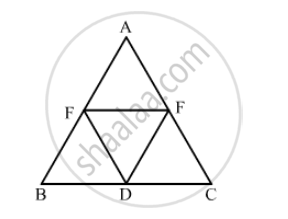
Fill in the blank in the following, so as to make the statement true:
A square is a rhombus in which .....
State with reason whether the following statement is ‘true’ or ‘false’.
Every parallelogram is a rectangle.
Draw a rectangle ABCD such that l(AB) = 6.0 cm and l (BC) = 4.5 cm.
The interior angle made by the side in a parallelogram is 90° then the parallelogram is a
For which of the following figures, diagonals are equal?
If diagonals of a quadrilateral are equal, it must be a rectangle.
Every trapezium is a rectangle.
PQRS is a rectangle. The perpendicular ST from S on PR divides ∠S in the ratio 2:3. Find ∠TPQ.
