Advertisements
Advertisements
Question
The shorter side of a parallelogram is 4.8 cm and the longer side is half as much again as the shorter side. Find the perimeter of the parallelogram.
Advertisements
Solution
\[\text{ Given }: \]
\[\text{ Shorter side } = 4 . 8 cm\]
\[\text{ Longer side } = \frac{4 . 8}{2} + 4 . 8 = 7 . 2 cm\]
\[\text{ Perimeter = Sum of all the sides } \]
\[ = 4 . 8 + 4 . 8 + 7 . 2 + 7 . 2\]
\[ = 24 \text{ cm }\]
RELATED QUESTIONS
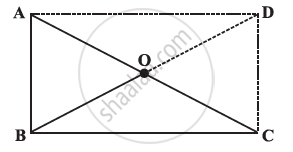
ABC is a right-angled triangle and O is the mid point of the side opposite to the right angle. Explain why O is equidistant from A, B and C. (The dotted lines are drawn additionally to help you)
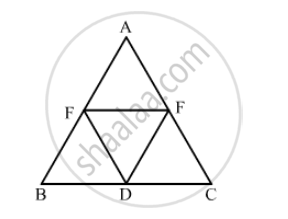
In the following figure, BDEF and DCEF are each a parallelogram. Is it true that BD = DC? Why or why not?
In a rectangle ABCD, prove that ∆ACB ≅ ∆CAD.
Draw a rectangle whose one side measures 8 cm and the length of each of whose diagonals is 10 cm.
A mason has made a concrete slab. He needs it to be rectangular. In what different ways can he make sure that it is rectangular?
ABCD is a rectangle whose diagonals AC and BD intersect at O. If ∠OAB = 46°, find ∠OBC
For which of the following figures, diagonals are equal?
PQRS is a rectangle. The perpendicular ST from S on PR divides ∠S in the ratio 2:3. Find ∠TPQ.
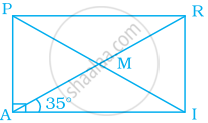
In rectangle PAIR, find ∠ARI, ∠RMI and ∠PMA.
Quadrilateral EFGH is a rectangle in which J is the point of intersection of the diagonals. Find the value of x if JF = 8x + 4 and EG = 24x – 8.
