Advertisements
Advertisements
Question
Quadrilateral EFGH is a rectangle in which J is the point of intersection of the diagonals. Find the value of x if JF = 8x + 4 and EG = 24x – 8.
Advertisements
Solution
Given, EFGH is a rectangle in which diagonals are intersecting at the point J.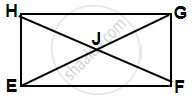
We know that, the diagonals of a rectangle bisect each other and are equal.
Then, EG = 2 × JF
⇒ 24x – 8 = 2(8x + 4)
⇒ 24x – 8 = 16x + 8
⇒ 24x – 16x = 8 + 8
⇒ 8x = 16
⇒ x = 2
APPEARS IN
RELATED QUESTIONS
Explain why a rectangle is a convex quadrilateral.
In a parallelogram ABCD, the diagonals bisect each other at O. If ∠ABC = 30°, ∠BDC = 10° and ∠CAB = 70°. Find:
∠DAB, ∠ADC, ∠BCD, ∠AOD, ∠DOC, ∠BOC, ∠AOB, ∠ACD, ∠CAB, ∠ADB, ∠ACB, ∠DBC and ∠DBA.
Which of the following statement is true for a rectangle?
Its diagonals are perpendicular.
Which of the following statement is true for a rectangle?
Its diagonals are equal and perpendicular, and bisect each other.
Which of the following statement true for a square?
Its diagonals are equal to its sides.
Fill in the blank in the following, so as to make the statement true:
A rectangle is a parallelogram in which .....
The sides of a rectangle are in the ratio 4 : 5. Find its sides if the perimeter is 90 cm.
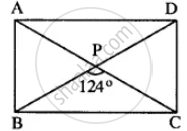
ABCD is a rectangle, if ∠BPC = 124°
Calculate:
- ∠BAP
- ∠ADP
A parallelogram PQRS is constructed with sides QR = 6 cm, PQ = 4 cm and ∠PQR = 90°. Then PQRS is a ______.
A line l is parallel to line m and a transversal p intersects them at X, Y respectively. Bisectors of interior angles at X and Y interesct at P and Q. Is PXQY a rectangle? Given reason.
