Advertisements
Advertisements
Question
Show that the bisectors of angles of a parallelogram form a rectangle
Advertisements
Solution
Given: A parallelogram in which bisector of angle A, B, C, D intersect at P, Q, R, S to form a quadrilateral PQRS.
To prove: Quadrilateral PQRS is a rectangle.
Proof: Since ABCD is a parallelogram.
Therefore, AB || DC.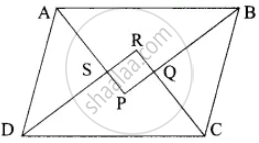
Now, AB || DC, and transversal AD cuts them, so we have
∠A + ∠D = 180°
`1/2 ∠"A" + 1/2 ∠ "D" = (180^circ)/2`
∠DAS + ∠ADS = 90°
But in ΔASD, we have
∠ADS + ∠DAS + ∠ASD = 180°
90° + ∠ASD = 180°
∠ASD = 90°
∠RSP = ∠ASD ...(vertically opposite angle)
∠RSP = 90°
Similarly, we can prove that
∠SRQ = 90°, ∠RQP = 90° and ∠QPS = 90°
Thus, PQRS is a quadrilateral each of whose angle is 90°.
Hence, PQRS is a rectangle.
APPEARS IN
RELATED QUESTIONS
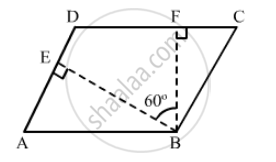
The angle between the altitudes of a parallelogram, through the same vertex of an obtuse angle of the parallelogram is 60°. Find the angles of the parallelogram.
In Fig. 17.29, suppose it is known that DE = DF. Then, is ΔABC isosceles? Why or why not?
Which of the following statement is true for a rectangle?
Its diagonals bisect each other.
Fill in the blank in the following, so as to make the statement true:
A square is a rhombus in which .....
The sides of a rectangle are in the ratio 4 : 5. Find its sides if the perimeter is 90 cm.
If diagonal of a rectangle is 26 cm and one side is 24 cm, find the other side.
A quadrilateral whose opposite sides and all the angles are equal is a ______.
If the diagonals of a quadrilateral are equal and bisect each other, then the quadrilateral is a ______.
All squares are rectangles.
PQRS is a rectangle. The perpendicular ST from S on PR divides ∠S in the ratio 2:3. Find ∠TPQ.
