Advertisements
Advertisements
Question
A parallelogram PQRS is constructed with sides QR = 6 cm, PQ = 4 cm and ∠PQR = 90°. Then PQRS is a ______.
Options
square
rectangle
rhombus
trapezium
Advertisements
Solution
A parallelogram PQRS is constructed with sides QR = 6 cm, PQ = 4 cm and ∠PQR = 90°. Then PQRS is a rectangle.
Explanation:
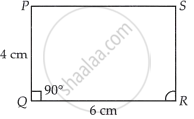
Given PQRS is a parallelogram such that PQ = 4 cm, QR = 6 cm and ∠PQR = 90°
∠PQR + ∠SRQ = 180° ...[∵ Sum of interior angles on same side of transversal is 180°]
`\implies` ∠SRQ = 90°
Similarly, all the interior angles are 90°.
Hence, PQRS is a rectangle.
APPEARS IN
RELATED QUESTIONS
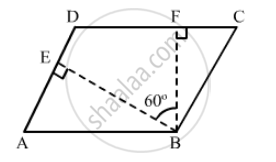
The angle between the altitudes of a parallelogram, through the same vertex of an obtuse angle of the parallelogram is 60°. Find the angles of the parallelogram.
Fill in the blank in the following, so as to make the statement true:
A rectangle is a parallelogram in which .....
Fill in the blank of the following, so as to make the statement true:
A square is a rectangle in which .....
Draw a rectangle whose one side measures 8 cm and the length of each of whose diagonals is 10 cm.
Diagonals of a rectangle PQRS are intersecting in point M. If ∠QMR = 50° find the measure of ∠MPS.
Show that the bisectors of angles of a parallelogram form a rectangle
For which of the following figures, diagonals are equal?
Rectangle is a regular quadrilateral.
Every rectangle is a trapezium.
Quadrilateral EFGH is a rectangle in which J is the point of intersection of the diagonals. Find the value of x if JF = 8x + 4 and EG = 24x – 8.
