Advertisements
Advertisements
Question
Which of the following statement is true for a rectangle?
Its diagonals are equal and perpendicular, and bisect each other.
Advertisements
Solution
False
The diagonals are not perpendicular to each other.
RELATED QUESTIONS
The shorter side of a parallelogram is 4.8 cm and the longer side is half as much again as the shorter side. Find the perimeter of the parallelogram.
In the following figure, BDEF and DCEF are each a parallelogram. Is it true that BD = DC? Why or why not?
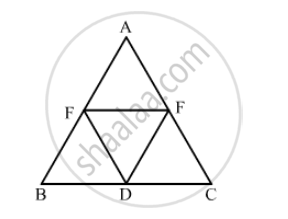
Fill in the blank in the following, so as to make the statement true:
A rectangle is a parallelogram in which .....
Prove that quadrilateral formed by the intersection of angle bisectors of all angles of a parallelogram is a rectangle.

Adjacent sides of a rectangle are 7 cm and 24 cm. Find the length of its diagonal.
ABCD is a rectangle whose diagonals AC and BD intersect at O. If ∠OAB = 46°, find ∠OBC
The interior angle made by the side in a parallelogram is 90° then the parallelogram is a
For which of the following figures, diagonals are equal?
Every trapezium is a rectangle.
Quadrilateral EFGH is a rectangle in which J is the point of intersection of the diagonals. Find the value of x if JF = 8x + 4 and EG = 24x – 8.
