Advertisements
Advertisements
Question
Which of the following statement is true for a rectangle?
Its diagonals are perpendicular.
Advertisements
Solution
False
RELATED QUESTIONS
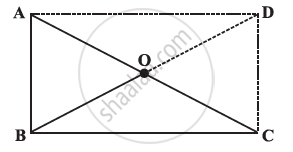
ABC is a right-angled triangle and O is the mid point of the side opposite to the right angle. Explain why O is equidistant from A, B and C. (The dotted lines are drawn additionally to help you)
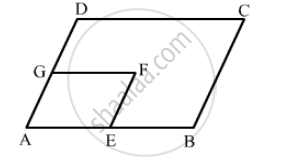
In the following figure, ABCD and AEFG are parallelograms. If ∠C = 55°, what is the measure of ∠F?
The sides of a rectangle are in the ratio 4 : 5. Find its sides if the perimeter is 90 cm.
Diagonals of a rectangle ABCD intersect at point O. If AC = 8 cm then find BO and if ∠CAD =35° then find ∠ACB.
The interior angle made by the side in a parallelogram is 90° then the parallelogram is a
For which of the following figures, all angles are equal?
Every parallelogram is a rectangle.
In a rectangle ABCD, AB = 25 cm and BC = 15. In what ratio does the bisector of ∠C divide AB?
PQRS is a rectangle. The perpendicular ST from S on PR divides ∠S in the ratio 2:3. Find ∠TPQ.
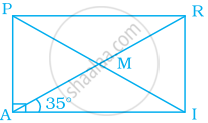
In rectangle PAIR, find ∠ARI, ∠RMI and ∠PMA.