Advertisements
Advertisements
प्रश्न
Which of the following statement is true for a rectangle?
Its diagonals are perpendicular.
Advertisements
उत्तर
False
संबंधित प्रश्न
Name the quadrilaterals whose diagonals are equal
Which of the following statement is true for a rectangle?
Its diagonals are perpendicular and bisect each other.
Which of the following statement is true for a square?
It is a rectangle.
Fill in the blank in the following, so as to make the statement true:
A square is a rhombus in which .....
The sides of a rectangle are in the ratio 2 : 3, and its perimeter is 20 cm. Draw the rectangle.
Draw a rectangle ABCD such that l(AB) = 6.0 cm and l (BC) = 4.5 cm.
If the diagonals of a parallelogram are of equal lengths, the parallelogram is a rectangle. Prove it.
If the adjacent angles of a parallelogram are equal, then the parallelogram is a ______.
Every parallelogram is a rectangle.
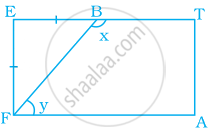
A playground is in the form of a rectangle ATEF. Two players are standing at the points F and B where EF = EB. Find the values of x and y.