Advertisements
Advertisements
प्रश्न
If the diagonals of a parallelogram are of equal lengths, the parallelogram is a rectangle. Prove it.
Advertisements
उत्तर
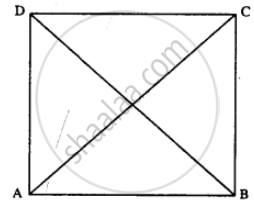
Given : //gm ABCD in which AC = BD
To Prove: ABCD is rectangle.
Proof : In ∆ABC and ∆ABD
AB = AB (Common)
AC = BD (Given)
BC = AD (opposite sides of ||gm)
∆ABC = ∆ABD (S.S.S. Rule)
∠A = ∠B
But AD // BC (opp. sides of ||gm are ||)
∠A + ∠B = 180°
∠A = ∠B = 90°
Similarly ∠D = ∠C = 90°
Hence ABCD is a rectangle.
APPEARS IN
संबंधित प्रश्न
In a parallelogram ABCD, the diagonals bisect each other at O. If ∠ABC = 30°, ∠BDC = 10° and ∠CAB = 70°. Find:
∠DAB, ∠ADC, ∠BCD, ∠AOD, ∠DOC, ∠BOC, ∠AOB, ∠ACD, ∠CAB, ∠ADB, ∠ACB, ∠DBC and ∠DBA.
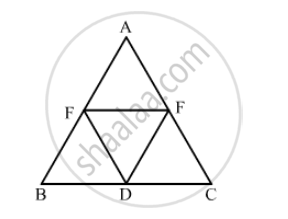
In the following figure, BDEF and DCEF are each a parallelogram. Is it true that BD = DC? Why or why not?
Fill in the blank in the following, so as to make the statement true:
A rectangle is a parallelogram in which .....
Draw a rectangle whose one side measures 8 cm and the length of each of whose diagonals is 10 cm.
Draw a rectangle ABCD such that l(AB) = 6.0 cm and l (BC) = 4.5 cm.
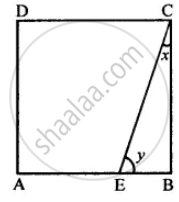
The following figure is a rectangle in which x: y = 3: 7; find the values of x and y.
For which of the following figures, diagonals are equal?
A parallelogram PQRS is constructed with sides QR = 6 cm, PQ = 4 cm and ∠PQR = 90°. Then PQRS is a ______.
Every parallelogram is a rectangle.
Quadrilateral EFGH is a rectangle in which J is the point of intersection of the diagonals. Find the value of x if JF = 8x + 4 and EG = 24x – 8.
