Advertisements
Advertisements
प्रश्न
If the diagonals of a parallelogram are of equal lengths, the parallelogram is a rectangle. Prove it.
Advertisements
उत्तर
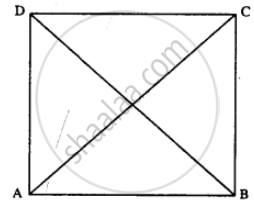
Given : //gm ABCD in which AC = BD
To Prove: ABCD is rectangle.
Proof : In ∆ABC and ∆ABD
AB = AB (Common)
AC = BD (Given)
BC = AD (opposite sides of ||gm)
∆ABC = ∆ABD (S.S.S. Rule)
∠A = ∠B
But AD // BC (opp. sides of ||gm are ||)
∠A + ∠B = 180°
∠A = ∠B = 90°
Similarly ∠D = ∠C = 90°
Hence ABCD is a rectangle.
APPEARS IN
संबंधित प्रश्न
Name the quadrilaterals whose diagonals are equal
In a parallelogram ABCD, the diagonals bisect each other at O. If ∠ABC = 30°, ∠BDC = 10° and ∠CAB = 70°. Find:
∠DAB, ∠ADC, ∠BCD, ∠AOD, ∠DOC, ∠BOC, ∠AOB, ∠ACD, ∠CAB, ∠ADB, ∠ACB, ∠DBC and ∠DBA.
Which of the following statement is true for a rectangle?
Its diagonals are perpendicular.
Which of the following statement true for a square?
Its diagonals bisect each other at right angle.
Find the length of the diagonal of a rectangle whose sides are 12 cm and 5 cm.
If diagonal of a rectangle is 26 cm and one side is 24 cm, find the other side.
Show that the bisectors of angles of a parallelogram form a rectangle
For which of the following figures, all angles are equal?
If diagonals of a quadrilateral are equal, it must be a rectangle.
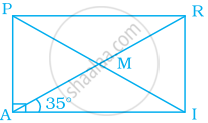
In rectangle PAIR, find ∠ARI, ∠RMI and ∠PMA.