Advertisements
Advertisements
प्रश्न
In Fig. 17.29, suppose it is known that DE = DF. Then, is ΔABC isosceles? Why or why not?
Advertisements
उत्तर
\[\text{ In } ∆ FDE: \]
\[DE = DF \]
\[ \therefore \angle FED = \angle DFE . . . . . . . . . . . . . (i) (\text{ angles opposite to equal sides })\]
\[\text{ In the } {II}^{gm} BDEF: \]
\[\angle FBD = \angle FED . . . . . . . (ii) (\text{ opposite angles of a parallelogram are equal })\]
\[\text{ In the } {II}^{gm} DCEF: \]
\[\angle DCE = \angle DFE . . . . . . (iii) (\text{ opposite angles of a parallelogram are equal })\]
\[\text{ From equations } (i), (ii) \text{ and } (iii): \]
\[\angle FBD = \angle DCE\]
\[\text{ In } \bigtriangleup ABC: \]
\[If \angle FBD = \angle DCE, \text{ then } AB = AC (\text{ sides opposite to equal angles }) . \]
\[\text{ Hence }, \bigtriangleup ABC \text{ is isosceles }.\]
संबंधित प्रश्न
Diagonals of a parallelogram ABCD intersect at O. AL and CM are drawn perpendiculars to BD such that L and M lie on BD. Is AL = CM? Why or why not?
Which of the following statement is true for a rectangle?
Its diagonals are equal and perpendicular, and bisect each other.
The sides of a rectangle are in the ratio 4 : 5. Find its sides if the perimeter is 90 cm.
Draw a square whose each side measures 4.8 cm.
State with reason whether the following statement is ‘true’ or ‘false’.
Every parallelogram is a rectangle.
Diagonals of a rectangle PQRS are intersecting in point M. If ∠QMR = 50° find the measure of ∠MPS.
Draw a rectangle ABCD such that l(AB) = 6.0 cm and l (BC) = 4.5 cm.
If diagonal of a rectangle is 26 cm and one side is 24 cm, find the other side.
A parallelogram PQRS is constructed with sides QR = 6 cm, PQ = 4 cm and ∠PQR = 90°. Then PQRS is a ______.
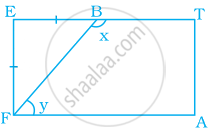
A playground is in the form of a rectangle ATEF. Two players are standing at the points F and B where EF = EB. Find the values of x and y.