Advertisements
Advertisements
प्रश्न
If diagonal of a rectangle is 26 cm and one side is 24 cm, find the other side.
Advertisements
उत्तर
Suppose ABCD is a rectangle.
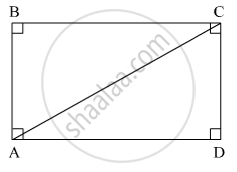
Here, segment AC is a diagonal and segment AD is one side of the rectangle ABCD.
l(AC) = 26 cm and l(AD) = 24 cm.
In right ∆ACD,
l(AC)2 = l(AD)2 + l(CD)2 ...(Pythagoras theorem)
⇒ l(CD)2 = l(AC)2 − l(AD)2
⇒ l(CD)2 = (26)2 − (24)2
⇒ l(CD)2 = 676 − 576 = 100
⇒ l(CD) = `sqrt(100)` = 10 cm
Thus, the other side of the rectangle is 10 cm.
संबंधित प्रश्न
Which of the following statement is true for a rectangle?
Its diagonals are equal.
Which of the following statement is true for a rectangle?
Its diagonals are perpendicular and bisect each other.
Which of the following statement is true for a rectangle?
Its diagonals are equal and perpendicular, and bisect each other.
Find the length of the diagonal of a rectangle whose sides are 12 cm and 5 cm.
Using opposite angles test for parallelogram, prove that every rectangle is a parallelogram.
Diagonals of a rectangle PQRS are intersecting in point M. If ∠QMR = 50° find the measure of ∠MPS.
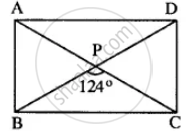
ABCD is a rectangle, if ∠BPC = 124°
Calculate:
- ∠BAP
- ∠ADP
If diagonals of a quadrilateral are equal, it must be a rectangle.
In rectangle READ, find ∠EAR, ∠RAD and ∠ROD

Construct a rectangle whose one side is 3 cm and a diagonal equal to 5 cm.
