Advertisements
Advertisements
प्रश्न
Draw a rectangle ABCD such that l(AB) = 6.0 cm and l (BC) = 4.5 cm.
Advertisements
उत्तर
Steps of Construction:
Step 1: Draw AB = 6 cm.
Step 2: Draw ∠ABX = 90º.
Step 3: With B as centre and radius 4.5 cm, draw an arc cutting the ray BX at C.
Step 4: With C as centre and radius 6 cm, draw an arc.
Step 5: With A as centre and radius 4.5 cm, draw an arc cutting the previous arc at D.
Step 6: Join AD and CD.
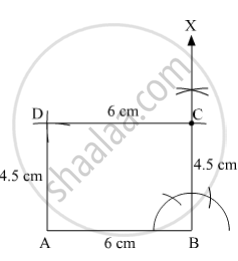
Here, ABCD is the required rectangle.
संबंधित प्रश्न
Diagonals of a parallelogram ABCD intersect at O. AL and CM are drawn perpendiculars to BD such that L and M lie on BD. Is AL = CM? Why or why not?
Which of the following statement is true for a rectangle?
Its diagonals are equal.
Fill in the blank in the following, so as to make the statement true:
A square is a rhombus in which .....
A window frame has one diagonal longer than the other. Is the window frame a rectangle? Why or why not?
In a rectangle ABCD, prove that ∆ACB ≅ ∆CAD.
Draw a rectangle whose one side measures 8 cm and the length of each of whose diagonals is 10 cm.
A mason has made a concrete slab. He needs it to be rectangular. In what different ways can he make sure that it is rectangular?
State with reason whether the following statement is ‘true’ or ‘false’.
Every parallelogram is a rectangle.
Every parallelogram is a rectangle.
In rectangle READ, find ∠EAR, ∠RAD and ∠ROD

