Advertisements
Advertisements
Question
Draw a rectangle ABCD such that l(AB) = 6.0 cm and l (BC) = 4.5 cm.
Advertisements
Solution
Steps of Construction:
Step 1: Draw AB = 6 cm.
Step 2: Draw ∠ABX = 90º.
Step 3: With B as centre and radius 4.5 cm, draw an arc cutting the ray BX at C.
Step 4: With C as centre and radius 6 cm, draw an arc.
Step 5: With A as centre and radius 4.5 cm, draw an arc cutting the previous arc at D.
Step 6: Join AD and CD.
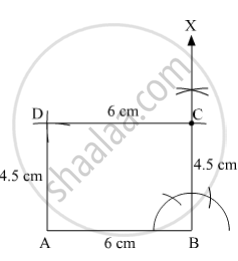
Here, ABCD is the required rectangle.
RELATED QUESTIONS
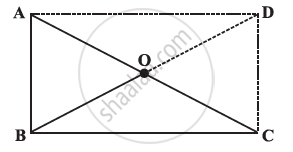
ABC is a right-angled triangle and O is the mid point of the side opposite to the right angle. Explain why O is equidistant from A, B and C. (The dotted lines are drawn additionally to help you)
Which of the following statement is true for a rectangle?
Its diagonals bisect each other.
Which of the following statement true for a square?
Its diagonals bisect each other at right angle.
Fill in the blank in the following, so as to make the statement true:
A square is a rhombus in which .....
Prove that quadrilateral formed by the intersection of angle bisectors of all angles of a parallelogram is a rectangle.

Diagonals of a rectangle ABCD intersect at point O. If AC = 8 cm then find BO and if ∠CAD =35° then find ∠ACB.
Adjacent sides of a rectangle are 7 cm and 24 cm. Find the length of its diagonal.
A quadrilateral whose opposite sides and all the angles are equal is a ______.
If the diagonals of a quadrilateral are equal and bisect each other, then the quadrilateral is a ______.
PQRS is a rectangle. The perpendicular ST from S on PR divides ∠S in the ratio 2:3. Find ∠TPQ.
