Advertisements
Advertisements
Question
Which of the following statement is true for a rectangle?
Its diagonals are perpendicular and bisect each other.
Advertisements
Solution
False
The diagonals are not perpendicular to each other.
RELATED QUESTIONS
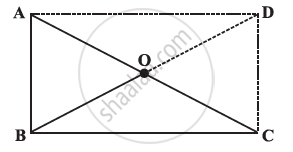
ABC is a right-angled triangle and O is the mid point of the side opposite to the right angle. Explain why O is equidistant from A, B and C. (The dotted lines are drawn additionally to help you)
Which of the following statement is true for a rectangle?
Its diagonals are perpendicular.
The sides of a rectangle are in the ratio 4 : 5. Find its sides if the perimeter is 90 cm.
Prove that quadrilateral formed by the intersection of angle bisectors of all angles of a parallelogram is a rectangle.

State with reason whether the following statement is ‘true’ or ‘false’.
Every parallelogram is a rectangle.
Adjacent sides of a rectangle are 7 cm and 24 cm. Find the length of its diagonal.
If diagonal of a rectangle is 26 cm and one side is 24 cm, find the other side.
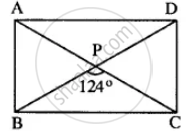
ABCD is a rectangle, if ∠BPC = 124°
Calculate:
- ∠BAP
- ∠ADP
Rectangle is a regular quadrilateral.
Every trapezium is a rectangle.
