Advertisements
Advertisements
Question
State with reason whether the following statement is ‘true’ or ‘false’.
Every parallelogram is a rectangle.
Options
True
False
Advertisements
Solution
This statement is False.
Reason:
If all angles of a quadrilateral are right angles, then it is a rectangle. It is not necessary for all angles of a parallelogram to be right angles. Therefore, not every parallelogram is a rectangle.
APPEARS IN
RELATED QUESTIONS
The shorter side of a parallelogram is 4.8 cm and the longer side is half as much again as the shorter side. Find the perimeter of the parallelogram.
In a parallelogram ABCD, the diagonals bisect each other at O. If ∠ABC = 30°, ∠BDC = 10° and ∠CAB = 70°. Find:
∠DAB, ∠ADC, ∠BCD, ∠AOD, ∠DOC, ∠BOC, ∠AOB, ∠ACD, ∠CAB, ∠ADB, ∠ACB, ∠DBC and ∠DBA.
Which of the following statement is true for a rectangle?
Its diagonals are equal.
Which of the following statement is true for a rectangle?
Its diagonals bisect each other.
Which of the following statement is true for a rectangle?
Its diagonals are equal and perpendicular, and bisect each other.
Find the length of the diagonal of a rectangle whose sides are 12 cm and 5 cm.
Using opposite angles test for parallelogram, prove that every rectangle is a parallelogram.
Diagonals of a rectangle PQRS are intersecting in point M. If ∠QMR = 50° find the measure of ∠MPS.
If diagonal of a rectangle is 26 cm and one side is 24 cm, find the other side.
The following figure is a rectangle in which x: y = 3: 7; find the values of x and y.
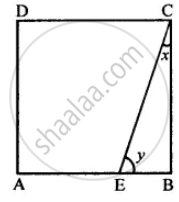
The interior angle made by the side in a parallelogram is 90° then the parallelogram is a
For which of the following figures, all angles are equal?
For which of the following figures, diagonals are equal?
A quadrilateral whose opposite sides and all the angles are equal is a ______.
If the diagonals of a quadrilateral are equal and bisect each other, then the quadrilateral is a ______.
A line l is parallel to line m and a transversal p intersects them at X, Y respectively. Bisectors of interior angles at X and Y interesct at P and Q. Is PXQY a rectangle? Given reason.
Construct a rectangle whose one side is 3 cm and a diagonal equal to 5 cm.
