Advertisements
Advertisements
Question
Find the length of the diagonal of a rectangle whose sides are 12 cm and 5 cm.
Advertisements
Solution

\[\text{ Using Pythagoras theorem }: \]
\[A D^2 + D C^2 = A C^2 \]
\[ 5^2 + {12}^2 = A C^2 \]
\[25 + 14 = A C^2 \]
\[169 = A C^2 \]
\[AC = \sqrt{169}\]
\[ = 13 cm\]
\[\text{ Thus, length of the diagonal is 13 cm } .\]
RELATED QUESTIONS
Which of the following statement is true for a rectangle?
Its diagonals are perpendicular and bisect each other.
Which of the following statement true for a square?
Its diagonals are equal to its sides.
Fill in the blank in the following, so as to make the statement true:
A rectangle is a parallelogram in which .....
Fill in the blank of the following, so as to make the statement true:
A square is a rectangle in which .....
In a rectangle ABCD, prove that ∆ACB ≅ ∆CAD.
If diagonal of a rectangle is 26 cm and one side is 24 cm, find the other side.
For which of the following figures, diagonals are equal?
In a rectangle ABCD, AB = 25 cm and BC = 15. In what ratio does the bisector of ∠C divide AB?
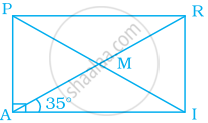
In rectangle PAIR, find ∠ARI, ∠RMI and ∠PMA.
A line l is parallel to line m and a transversal p intersects them at X, Y respectively. Bisectors of interior angles at X and Y interesct at P and Q. Is PXQY a rectangle? Given reason.
