Advertisements
Advertisements
Question
In a parallelogram ABCD, the diagonals bisect each other at O. If ∠ABC = 30°, ∠BDC = 10° and ∠CAB = 70°. Find:
∠DAB, ∠ADC, ∠BCD, ∠AOD, ∠DOC, ∠BOC, ∠AOB, ∠ACD, ∠CAB, ∠ADB, ∠ACB, ∠DBC and ∠DBA.
Advertisements
Solution
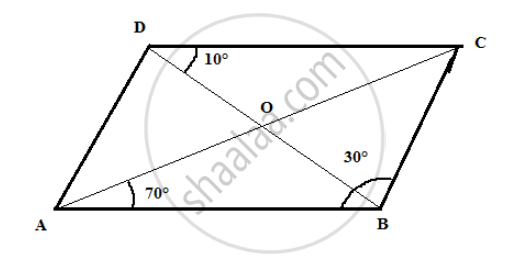
\[\angle ABC = 30°\]
\[ \therefore \angle ADC = 30° \left( \text{ opposite angle of the parallelogram }\right)\]
\[\text{ and } \angle BDA = \angle ADC - \angle BDC = 30° - 10° = 20°\]
\[\angle BAC = \angle ACD = 70°(\text{ alternate angle })\]
\[\text{ In } \bigtriangleup ABC: \]
\[\angle CAB + \angle ABC + \angle BCA = 180°\]
\[70° + 30° + \angle BCA = 180°\]
\[ \therefore \angle BCA = 80°\]
\[\angle DAB = \angle DAC + \angle CAB = 70° + 80°= 150°\]
\[\angle BCD = 150° \left( \text{ opposite angle of the parallelogram } \right)\]
\[\angle DCA = \angle CAB = 70°\]
\[\text{ In } \bigtriangleup DOC: \]
\[\angle ODC + \angle DOC + \angle OCD = 180\]
\[10° + 70°+ \angle DOC = 180°\]
\[ \therefore \angle DOC = 100°\]
\[\angle DOC + \angle BOC = 180°\]
\[\angle BOC = 180° - 100°\]
\[\angle BOC = 80°\]
\[\angle AOD = \angle BOC = 80° \left( \text{ vertically opposite angles } \right) \]
\[\angle AOB = \angle DOC = 100° \left( \text{ vertically opposite angles } \right) \]
\[\angle CAB = 70° \left( \text{ given } \right)\]
\[\angle ADB = 20°\]
\[\angle DBA = \angle BDC = 10°(\text{ alternate angle })\]
\[\angle ADB = \angle DBC = 20°(\text{ alternate angle })\]
RELATED QUESTIONS
In Fig. 17.29, suppose it is known that DE = DF. Then, is ΔABC isosceles? Why or why not?
Which of the following statement is true for a rectangle?
It has all its sides of equal length.
Which of the following statement is true for a rectangle?
Its diagonals bisect each other.
Which of the following statement is true for a rectangle?
All rectangles are squares.
A mason has made a concrete slab. He needs it to be rectangular. In what different ways can he make sure that it is rectangular?
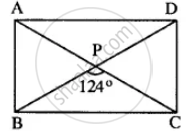
ABCD is a rectangle, if ∠BPC = 124°
Calculate:
- ∠BAP
- ∠ADP
If the diagonals of a parallelogram are of equal lengths, the parallelogram is a rectangle. Prove it.
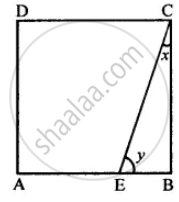
The following figure is a rectangle in which x: y = 3: 7; find the values of x and y.
The interior angle made by the side in a parallelogram is 90° then the parallelogram is a
All squares are rectangles.
