Advertisements
Advertisements
Question
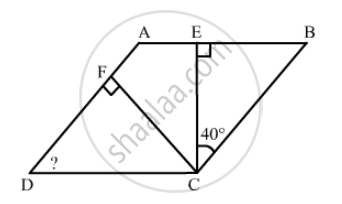
Find the angles marked with a question mark shown in Fig. 17.27
Advertisements
Solution
\[\text{ In } \bigtriangleup CEB: \]
\[\angle ECB + \angle CBE + \angle BEC = 180° (\text{ angle sum property of a triangle })\]
\[40° + 90° + \angle EBC = 180° \]
\[ \therefore \angle EBC = 50° \]
\[\text{ Also }, \angle EBC = \angle ADC = 50° \left( \text{ opposite angle of a parallelogram } \right)\]
\[\text{ In } \bigtriangleup FDC: \]
\[\angle FDC + \angle DCF + \angle CFD = 180° \]
\[50° + 90° + \angle DCF = 180° \]
\[ \therefore \angle DCF = 40° \]
\[\text{ Now }, \angle BCE + \angle ECF + \angle FCD + \angle FDC = 180° (\text{ in a parallelogram, the sum of alternate angles is } 180° )\]
\[50° + 40° + \angle ECF + 40° = 180° \]
\[\angle ECF = 180° - 50° + 40° - 40° = 50° \]
RELATED QUESTIONS
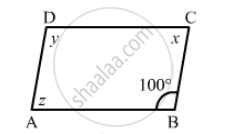
The following figure is parallelogram. Find the degree values of the unknowns x, y, z.
The sum of two opposite angles of a parallelogram is 130°. Find all the angles of the parallelogram.
Points E and F lie on diagonal AC of a parallelogram ABCD such that AE = CF. What type of quadrilateral is BFDE?
Fill in the blank, in each of the following, so as to make the statement true:
If the diagonals of a parallelogram bisect each other at right angles, then it is a ......
Measure of one angle of a rhombus is 50°, find the measures of remaining three angles.
In rhombus ABCD;
(i) if ∠A = 74° ; find ∠B and ∠C.
(ii) if AD = 7.5 cm ; find BC and CD.
The lengths of the diagonals of a Rhombus are 12 cm and 16 cm. Find the side of the rhombus
If a diagonal of a quadrilateral bisects both the angles, then it is a ______.
A rhombus is a parallelogram in which ______ sides are equal.
ABCD is a rhombus such that the perpendicular bisector of AB passes through D. Find the angles of the rhombus.
Hint: Join BD. Then ∆ABD is equilateral.
