Advertisements
Advertisements
Question
The measure of one angle of a parallelogram is 70°. What are the measures of the remaining angles?
Advertisements
Solution
\[\text{ Given that one angle of the parallelogram is } 70° . \]
\[\text{ Since opposite angles have same value, if one is }70° , \text{ then the one directly opposite will also be } 70° . \]
\[\text{ So, let one angle be }x° . \]
\[x° + 70° = 180° (\text{ the sum of adjacent angles of a parallelogram is } 180° )\]
\[x° = 180° - 70° \]
\[x° = 110° \]
\[\text{ Thus, the remaining angles are }110° , 110° \text{ and }70° . \]
RELATED QUESTIONS
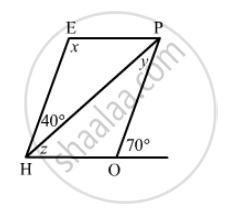
In the adjacent figure HOPE is a parallelogram. Find the angle measures x,y and z. State the geometrical truths you use to find them.
Which of the following statement is true for a rhombus?
It has two pairs of parallel sides.
Draw a rhombus, having each side of length 3.5 cm and one of the angles as 40°.
One side of a rhombus is of length 4 cm and the length of an altitude is 3.2 cm. Draw the rhombus.
ABCD is a rhombus whose diagonals intersect at O. If AB = 10 cm, diagonal BD = 16 cm, find the length of diagonal AC.
In a rhombus PQRS if PQ = 7.5 cm then find QR. If ∠QPS = 75° then find the measure of ∠PQR and ∠SRQ.
Diagonals of a rhombus are 20 cm and 21 cm respectively, then find the side of rhombus and its perimeter.
The given figure shows a rhombus ABCD in which angle BCD = 80°. Find angles x and y.
The lengths of the diagonals of a Rhombus are 12 cm and 16 cm. Find the side of the rhombus
Construct a rhombus whose side is 5 cm and one angle is of 60°.
