Advertisements
Advertisements
Question
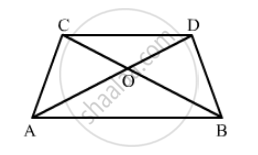
Given below is a parallelogram ABCD. Complete each statement along with the definition or property used.
(i) AD =
(ii) ∠DCB =
(iii) OC =
(iv) ∠DAB + ∠CDA =
Advertisements
Solution
The correct figure is
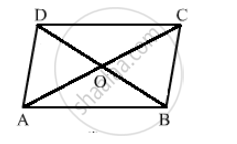
\[(i)\]\[AD = BC (\text{ opposite sides of a parallelogram are equal })\]
\[(ii)\] \[\angle DCB = \angle BAD \left( \text{ opposite angles are equal } \right)\]
\[(iii)\] \[OC = OA \left( \text{ diagonals of a prallelogram bisect each other } \right)\]
\[(iv)\] \[\angle DAB + \angle CDA = 180° \left( \text{ the sum of two adjacent angles of a parallelogram is } {180}^0 \right)\]
RELATED QUESTIONS
All rhombuses are parallelograms.
Which of the following statement is true for a rhombus?
It has two pairs of parallel sides.
Which of the following statement is true for a rhombus?
It has all its sides of equal lengths.
Which of the following statement is true for a rhombus?
It is a parallelogram.
Fill in the blank, in the following, so as to make the statement true:
The diagonals of a rhombus ...... each other at ...... angles.
Diagonals PR and QS of a rhombus PQRS are 20 cm and 48 cm respectively. Find the length of side PQ.
Draw a rhombus KLMN such that its side is 4 cm and m∠K = 75°.
ABCD is a rhombus. If ∠BCA = 35°. find ∠ADC.
A quadrilateral whose all sides are equal, opposite angles are equal and the diagonals bisect each other at right angles is a ______.
All rhombuses are squares.
