Advertisements
Advertisements
प्रश्न
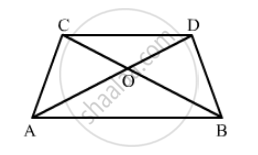
Given below is a parallelogram ABCD. Complete each statement along with the definition or property used.
(i) AD =
(ii) ∠DCB =
(iii) OC =
(iv) ∠DAB + ∠CDA =
Advertisements
उत्तर
The correct figure is
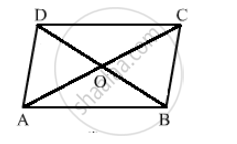
\[(i)\]\[AD = BC (\text{ opposite sides of a parallelogram are equal })\]
\[(ii)\] \[\angle DCB = \angle BAD \left( \text{ opposite angles are equal } \right)\]
\[(iii)\] \[OC = OA \left( \text{ diagonals of a prallelogram bisect each other } \right)\]
\[(iv)\] \[\angle DAB + \angle CDA = 180° \left( \text{ the sum of two adjacent angles of a parallelogram is } {180}^0 \right)\]
संबंधित प्रश्न
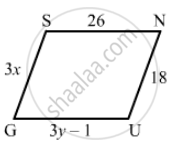
In the following figure GUNS and RUNS are parallelogram. Find x and y.
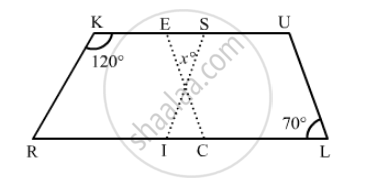
In the following figure RISK and CLUE are parallelograms. Find the measure of x.
The measure of one angle of a parallelogram is 70°. What are the measures of the remaining angles?
In a parallelogram ABCD, ∠D = 135°, determine the measure of ∠A and ∠B.
The sum of two opposite angles of a parallelogram is 130°. Find all the angles of the parallelogram.
All the angles of a quadrilateral are equal to each other. Find the measure of each. Is the quadrilateral a parallelogram? What special type of parallelogram is it?
Points E and F lie on diagonal AC of a parallelogram ABCD such that AE = CF. What type of quadrilateral is BFDE?
If the diagonals of a rhombus are 12 cm and 16cm, find the length of each side.
Which of the following statement is true for a rectangle?
Its diagonals are equal and bisect each other.
If all pairs of adjacent sides of a quadrilateral are congruent then it is called ______.
