Advertisements
Advertisements
प्रश्न
If all pairs of adjacent sides of a quadrilateral are congruent then it is called ______.
विकल्प
Rectangle
Parallelogram
Trapezium
Rhombus
Advertisements
उत्तर
If all pairs of adjacent sides of a quadrilateral are congruent then it is called Rhombus.
Explanation:
When all the pairs of the adjacent sides of a quadrilateral are congruent then it is a rhombus.
APPEARS IN
संबंधित प्रश्न
All rhombuses are parallelograms.
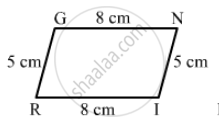
Can the following figure be parallelogram. Justify your answer.
Two adjacent angles of a parallelogram are as 1 : 2. Find the measures of all the angles of the parallelogram.
In the following Figure ABCD is a arallelogram, CE bisects ∠C and AF bisects ∠A. In each of the following, if the statement is true, give a reason for the same:
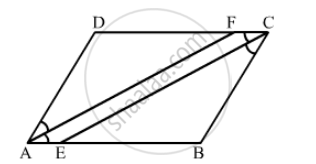
(i) ∠A = ∠C
(ii) \[\angle FAB = \frac{1}{2}\angle A\]
(iii) \[\angle DCE = \frac{1}{2}\angle C\]
(iv) \[\angle CEB = \angle FAB\]
(v) CE || AF
Points E and F lie on diagonal AC of a parallelogram ABCD such that AE = CF. What type of quadrilateral is BFDE?
In a parallelogram ABCD, AB = 10 cm, AD = 6 cm. The bisector of ∠A meets DC in E, AEand BC produced meet at F. Find te length CF.
Which of the following statement is true for a rhombus?
It is a parallelogram.
Fill in the blank, inthe following, so as to make the statement true:
A square is a rhombus in which .....
The diagonals of a parallelogram are not perpendicular. Is it a rhombus? Why or why not?
ABCD is a rhombus. If ∠ACB = 40°, find ∠ADB.
Draw a rhombus ABCD, if AB = 6 cm and AC = 5 cm.
Which of the following statement is true for a rectangle?
Its diagonals are equal and bisect each other.
Identify all the quadrilateral that have Four sides of equal length
State with reason whether the following statement is ‘true’ or ‘false’.
Every parallelogram is a rhombus.
ABCD is a rhombus. If ∠BCA = 35°. find ∠ADC.
A quadrilateral whose all sides are equal, opposite angles are equal and the diagonals bisect each other at right angles is a ______.
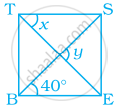
In the figure, BEST is a rhombus, Then the value of y – x is ______.
A rhombus is a parallelogram in which ______ sides are equal.
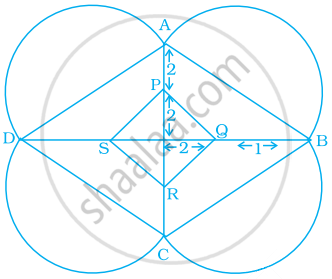
A Rangoli has been drawn on a flor of a house. ABCD and PQRS both are in the shape of a rhombus. Find the radius of semicircle drawn on each side of rhombus ABCD.