Advertisements
Advertisements
प्रश्न
ABCD is a rhombus. If ∠ACB = 40°, find ∠ADB.
Advertisements
उत्तर
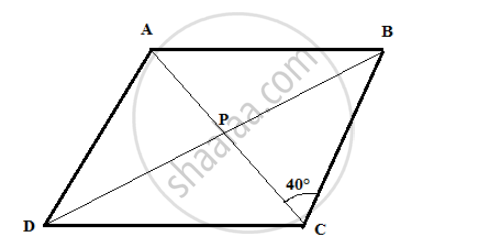
\[\text{ In a rhombus, the diagonals are perpendicular } . \]
\[ \therefore \angle BPC = 90°\]
\[\text{ From ∆ BPC, the sum of angles is }180° . \]
\[ \therefore \angle CBP + \angle BPC + \angle PBC = 180°\]
\[\angle CBP = 180° - \angle BPC - \angle PBC\]
\[\angle CBP = 180° - 40° - 90° = 50° \]
\[\angle ADB = \angle CBP = 50°(\text{ alternate angle })\]
संबंधित प्रश्न
The perimeter of a parallelogram is 150 cm. One of its sides is greater than the other by 25 cm. Find the length of the sides of the parallelogram.
Which of the following statement is true for a rhombus?
Two of its angles are at right angles
Which of the following statement is true for a rhombus?
Its diagonals are equal and perpendicular.
Which of the following statement is true for a rhombus?
It is a quadrilateral.
Fill in the blank, in the following, so as to make the statement true:
A rhombus is a parallelogram in which ......
Fill in the blank, inthe following, so as to make the statement true:
A rhombus has all its sides of ...... length.
One side of a rhombus is of length 4 cm and the length of an altitude is 3.2 cm. Draw the rhombus.
In rhombus ABCD;
(i) if ∠A = 74° ; find ∠B and ∠C.
(ii) if AD = 7.5 cm ; find BC and CD.
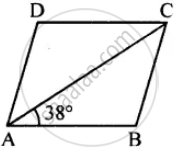
ABCD is a rhombus. If ∠BAC = 38°, find :
(i) ∠ACB
(ii) ∠DAC
(iii) ∠ADC.
If all sides of a quadrilateral are equal, it is a ______.
