Advertisements
Advertisements
Question
ABCD is a rhombus. If ∠ACB = 40°, find ∠ADB.
Advertisements
Solution
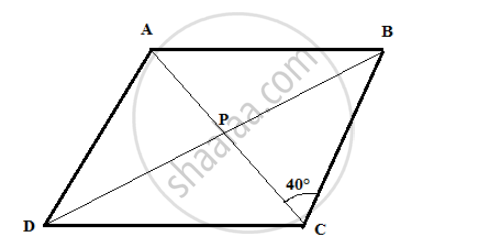
\[\text{ In a rhombus, the diagonals are perpendicular } . \]
\[ \therefore \angle BPC = 90°\]
\[\text{ From ∆ BPC, the sum of angles is }180° . \]
\[ \therefore \angle CBP + \angle BPC + \angle PBC = 180°\]
\[\angle CBP = 180° - \angle BPC - \angle PBC\]
\[\angle CBP = 180° - 40° - 90° = 50° \]
\[\angle ADB = \angle CBP = 50°(\text{ alternate angle })\]
RELATED QUESTIONS
The following figure is parallelogram. Find the degree value of the unknown x, y, z.
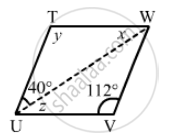
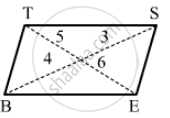
Can the following figure be parallelogram. Justify your answer.
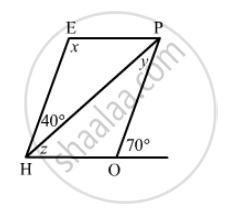
In the adjacent figure HOPE is a parallelogram. Find the angle measures x,y and z. State the geometrical truths you use to find them.
The measure of one angle of a parallelogram is 70°. What are the measures of the remaining angles?
The sum of two opposite angles of a parallelogram is 130°. Find all the angles of the parallelogram.
Which of the following statement is true for a rhombus?
It has two pairs of equal sides.
Fill in the blank, inthe following, so as to make the statement true:
A rhombus has all its sides of ...... length.
Draw a rhombus, having each side of length 3.5 cm and one of the angles as 40°.
Draw a rhombus ABCD, if AB = 6 cm and AC = 5 cm.
Diagonals of a rhombus are 20 cm and 21 cm respectively, then find the side of rhombus and its perimeter.
