Advertisements
Advertisements
Question
ABCD is a rhombus and its diagonals intersect at O.
(i) Is ∆BOC ≅ ∆DOC? State the congruence condition used?
(ii) Also state, if ∠BCO = ∠DCO.
Advertisements
Solution
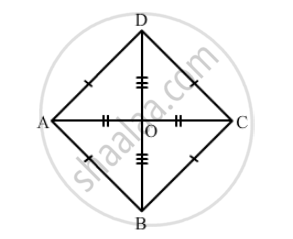
(i) Yes
\[\text{ In } ∆ BCO \text{ and } ∆ DCO: \]
\[OC = OC (\text{ common })\]
\[BC = DC (\text{ all sides of a rhombus are equal })\]
\[BO = OD (\text{ diagonals of a rhomus bisect each other })\]
\[\text{ By SSS congruence }: \]
\[ ∆ BCO \cong ∆ DCO\]
Yes
By c.p.c.t:
\[\angle BCO = \angle DCO\]
RELATED QUESTIONS
Two opposite angles of a parallelogram are (3x − 2)° and (50 − x)°. Find the measure of each angle of the parallelogram.
In a parallelogram ABCD, ∠D = 135°, determine the measure of ∠A and ∠B.
Points E and F lie on diagonal AC of a parallelogram ABCD such that AE = CF. What type of quadrilateral is BFDE?
Which of the following statement is true for a rhombus?
Its diagonals are equal and perpendicular.
Draw a rhombus ABCD, if AB = 6 cm and AC = 5 cm.
Identify all the quadrilateral that have Four sides of equal length
Diagonals of a rhombus are 20 cm and 21 cm respectively, then find the side of rhombus and its perimeter.
ABCD is a rhombus. If ∠BCA = 35°. find ∠ADC.
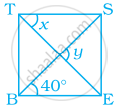
In the figure, BEST is a rhombus, Then the value of y – x is ______.
Construct a rhombus CLUE in which CL = 7.5 cm and LE = 6 cm.
