Advertisements
Advertisements
Question
In a rhombus PQRS if PQ = 7.5 cm then find QR. If ∠QPS = 75° then find the measure of ∠PQR and ∠SRQ.
Advertisements
Solution
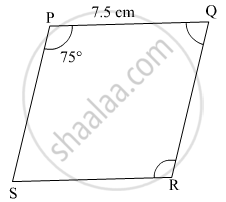
PQ = 7.5 cm ...[Given]
`square`PQRS is a rhombus. ...[Given]
∴ QR = PQ ...[Sides of a rhombus are congruent]
∴ QR = 7.5 cm
∠QPS = 75° ...[Given]
∠QPS + ∠PQR = 180° ...[Adjacent angles of a rhombus are supplementary]
∴ 75° + ∠PQR = 180°
∴ ∠PQR = 180° – 75°
∴ ∠PQR = 105°
∠SRQ = ∠QPS ...[Opposite angles of a rhombus]
∴ ∠SRQ = 75°
APPEARS IN
RELATED QUESTIONS
Can the following figure be parallelogram. Justify your answer.
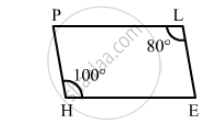
Can the following figure be parallelogram. Justify your answer.
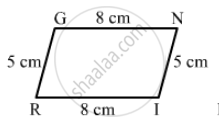
The measure of one angle of a parallelogram is 70°. What are the measures of the remaining angles?
In a parallelogram ABCD, ∠D = 135°, determine the measure of ∠A and ∠B.
ABCD is a parallelogram in which ∠A = 70°. Compute ∠B, ∠C and ∠D.
The sum of two opposite angles of a parallelogram is 130°. Find all the angles of the parallelogram.
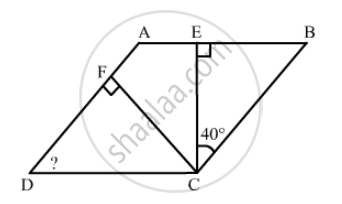
Find the angles marked with a question mark shown in Fig. 17.27
In the following Figure ABCD is a arallelogram, CE bisects ∠C and AF bisects ∠A. In each of the following, if the statement is true, give a reason for the same:
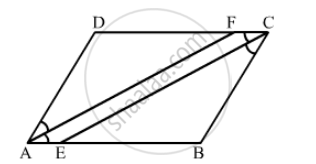
(i) ∠A = ∠C
(ii) \[\angle FAB = \frac{1}{2}\angle A\]
(iii) \[\angle DCE = \frac{1}{2}\angle C\]
(iv) \[\angle CEB = \angle FAB\]
(v) CE || AF
Which of the following statement is true for a rhombus?
It has two pairs of parallel sides.
Which of the following statement is true for a rhombus?
Its diagonals are equal and perpendicular.
Fill in the blank, inthe following, so as to make the statement true:
A rhombus has all its sides of ...... length.
The diagonals of a parallelogram are not perpendicular. Is it a rhombus? Why or why not?
Draw a rhombus ABCD, if AB = 6 cm and AC = 5 cm.
The diagonals of a quadrilateral are of lengths 6 cm and 8 cm. If the diagonals bisect each other at right angles, what is the length of each side of the quadrilateral?
A quadrilateral whose all sides are equal, opposite angles are equal and the diagonals bisect each other at right angles is a ______.
If a diagonal of a quadrilateral bisects both the angles, then it is a ______.
A rhombus is a parallelogram in which ______ sides are equal.
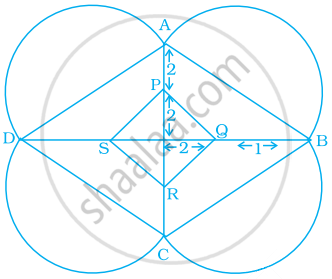
A Rangoli has been drawn on a flor of a house. ABCD and PQRS both are in the shape of a rhombus. Find the radius of semicircle drawn on each side of rhombus ABCD.