Advertisements
Advertisements
Question
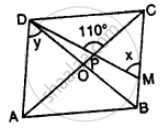
The given figure shows a rhombus ABCD in which angle BCD = 80°. Find angles x and y.
Advertisements
Solution
In rhombus ABCD, diagonals AC and BD bisect each other at 90°
∠BCD = 80°
Diagonals bisect the opposite angles also ∠BCD =
∠BAD (Opposite angles of rhombus)
∠BAD = 80° and ∠ABC = ∠ADC = 180° – 80° = 100°
Diagonals bisect opposite angles
∠OCB or ∠PCB =`80^circ/2` = 40°
In ∆PCM,
Ext. CPD = ∠OCB + ∠PMC
110° = 40° + x
⇒ x = 110° – 40° = 70°
and ∠ADO = `1/2` ∠ADC = `1/2 xx 100^circ = 50^circ`
Hence x = 70° and y = 50°
APPEARS IN
RELATED QUESTIONS
Which of the following statement is true for a rhombus?
It has two pairs of parallel sides.
Which of the following statement is true for a rhombus?
Its diagonals bisect each other at right angles.
One side of a rhombus is of length 4 cm and the length of an altitude is 3.2 cm. Draw the rhombus.
Diagonals of a rhombus are 20 cm and 21 cm respectively, then find the side of rhombus and its perimeter.
If all pairs of adjacent sides of a quadrilateral are congruent then it is called ______.
If opposite angles of a rhombus are (2x)° and (3x - 40)° then value of x is ______.
Lengths of diagonals of a rhombus ABCD are 16 cm and 12 cm. Find the side and perimeter of the rhombus.
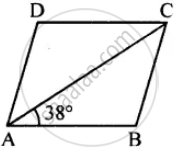
ABCD is a rhombus. If ∠BAC = 38°, find :
(i) ∠ACB
(ii) ∠DAC
(iii) ∠ADC.
The lengths of the diagonals of a Rhombus are 12 cm and 16 cm. Find the side of the rhombus
A rhombus is a parallelogram in which ______ sides are equal.
