Advertisements
Advertisements
Question
Which of the following statement is true for a rhombus?
Its diagonals bisect each other at right angles.
Advertisements
Solution
True
RELATED QUESTIONS
Name the quadrilaterals whose diagonals are perpendicular bisectors of each other
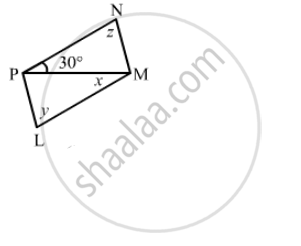
The following figure is parallelogram. Find the degree values of the unknown x, y, z.
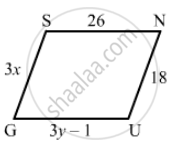
In the following figure GUNS and RUNS are parallelogram. Find x and y.
The perimeter of a parallelogram is 150 cm. One of its sides is greater than the other by 25 cm. Find the length of the sides of the parallelogram.
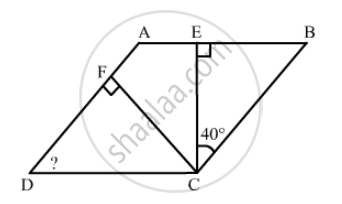
Find the angles marked with a question mark shown in Fig. 17.27
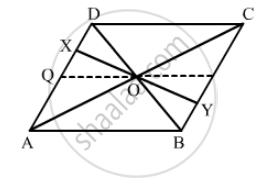
Diagonals of parallelogram ABCD intersect at O as shown in the following fegure. XY contains O, and X, Y are points on opposite sides of the parallelogram. Give reasons for each of the following:
(i) OB = OD
(ii) ∠OBY = ∠ODX
(iii) ∠BOY = ∠DOX
(iv) ∆BOY ≅ ∆DOX
Now, state if XY is bisected at O.
Which of the following statement is true for a rhombus?
It has all its sides of equal lengths.
Which of the following statement is true for a rhombus?
It is a quadrilateral.
Draw a rhombus ABCD, if AB = 6 cm and AC = 5 cm.
Draw a rhombus KLMN such that its side is 4 cm and m∠K = 75°.
