Advertisements
Advertisements
Question
Draw a rhombus KLMN such that its side is 4 cm and m∠K = 75°.
Advertisements
Solution
Steps of Construction:
Step 1: Draw KL = 4 cm.
Step 2: Draw ∠LKX = 75º.
Step 3: With K as the centre and radius of 4 cm, draw an arc cutting the ray KX at N.
Step 4: With N as centre and radius 4 cm, draw an arc.
Step 5: With L as the center and a radius of 4 cm, draw an arc cutting the previous arc at M.
Step 6: Join LM and NM.
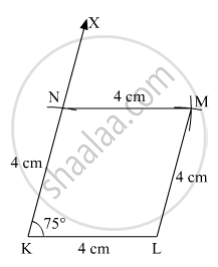
Here, KLMN is the required rhombus.
RELATED QUESTIONS
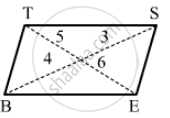
Can the following figure be parallelogram. Justify your answer.
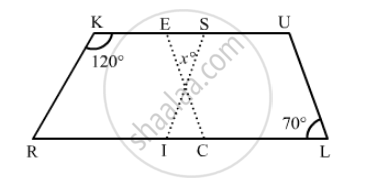
In the following figure RISK and CLUE are parallelograms. Find the measure of x.
Two adjacent sides of a parallelogram are 4 cm and 3 cm respectively. Find its perimeter.
Which of the following statement is true for a rhombus?
It has two pairs of equal sides.
Which of the following statement is true for a rhombus?
It can be a square.
One side of a rhombus is of length 4 cm and the length of an altitude is 3.2 cm. Draw the rhombus.
The diagonals of a quadrilateral are of lengths 6 cm and 8 cm. If the diagonals bisect each other at right angles, what is the length of each side of the quadrilateral?
If opposite angles of a rhombus are (2x)° and (3x - 40)° then value of x is ______.
In a rhombus diagonals intersect at ______ angles.
ABCD is a rhombus such that the perpendicular bisector of AB passes through D. Find the angles of the rhombus.
Hint: Join BD. Then ∆ABD is equilateral.
